How to Make Money Selling Digital Products in Europe
Complete Beginner’s Guide
This post may contain affiliate links. We may earn a commission at no extra cost to you.
The Spreadsheet That Changed Everything
In 2022, a friend asked for help organising her small business finances. She needed something simple — a way to track her income, expenses, and monthly profit.
It took about an hour to build in Google Sheets. She loved it.
“You should sell this,” she said.
That felt ridiculous. Who pays for a spreadsheet?
Turns out — a lot of people.
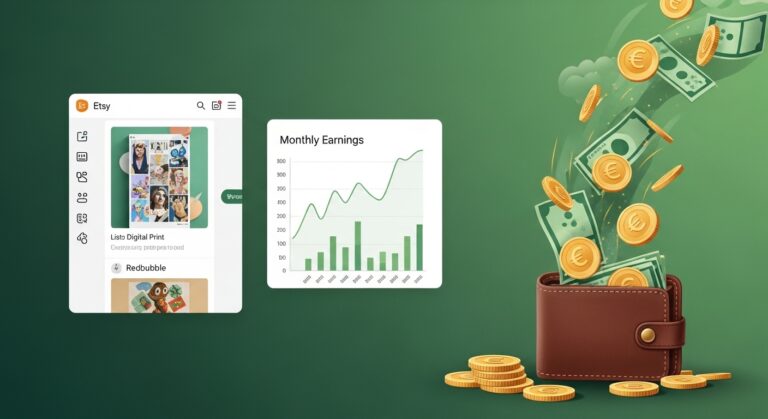
A few weeks later, the tracker was listed on Etsy for €7. Then forgotten about. A month later, there were 12 sales. €84. From something that took one hour to make.
That is the idea behind digital products. You make something once. Then it sells again and again — while you sleep, while you work, while you are out living your life.
This guide will show you exactly how to do the same thing. What to create, where to sell it, how to get your first sale, and how to grow from there. Even if you have never sold anything online before.
What Are Digital Products?
A digital product is anything you create and sell online that does not have a physical form. There is nothing to package, ship, or store. The buyer pays, downloads, and uses it instantly.
Simple examples:
- A budget tracker in Google Sheets
- A PDF guide called “How to Move to Berlin”
- A Canva template for Instagram posts
- A short video course on cooking basics
- A printable wall art design
Once you upload the file, it can be sold to one person or ten thousand people. The work stays the same. The income scales.
This is what makes digital products different from most other ways to earn money online. You are not trading your time for money. You are building something once and letting it earn for you over time.
Why Digital Products Work So Well in Europe
Europe is one of the best places in the world to sell digital products. Here is why.
Everyone is online. Internet access across Europe is high. People search for solutions, tools, and guides every single day.
Multiple languages mean multiple markets. A product in English already reaches a massive audience. Translate it into German, French, Spanish, or Italian, and you open entirely new markets — often with less competition.
Platforms already exist and work here. Etsy, Gumroad, Amazon Kindle, and Teachable all operate across Europe. You can start selling today without building your own website.
Specific problems still need specific solutions. There is a huge demand for products that help with European life — moving to a new city, navigating local tax systems, learning a language, adapting to a new country. If you have lived that experience, you have something valuable to sell.
Zero shipping costs. You can sell to someone in Portugal, Poland, or the Netherlands at no extra cost. No post office trips, no packaging, no delays.
What Kind of Digital Products Can You Sell?
There are five main categories that sell well in Europe. You do not need to try all of them. Pick the one that fits what you already know or can easily learn.
1. Templates and Planners
These are structured tools that help people organise something in their life or work.
Popular examples:
- Budget trackers (Google Sheets, Excel, Notion)
- Wedding planners
- Meal planners for the week
- Social media content calendars
- Resume and CV templates
- Project management dashboards
Where to sell: Etsy, Gumroad, Creative Market
Typical price: €5 – €30
Templates sell because people want to save time. Instead of building a system from scratch, they pay a few euros and get something ready to use immediately. That is a very easy purchase to justify.
2. eBooks and PDF Guides
If you know something useful, write it down and sell it. It does not need to be a long book — a focused, practical PDF of 20 to 50 pages can sell very well.
Popular examples:
- “How to Move to Berlin: The Complete Expat Guide”
- “Beginner’s Guide to Investing in Europe”
- “Easy Budget Recipes for Students in the UK”
- “How to Pass Your Driving Test in Ireland”
- “Freelancing in the Netherlands: Taxes, Permits, and First Clients”
Where to sell: Amazon Kindle Direct Publishing, Gumroad
Typical price: €5 – €20
The best eBooks solve a specific problem for a specific person. Not “a guide to moving to Europe” — that is too broad. But “a guide to moving to Berlin as a non-EU citizen” — that reaches exactly the right person.
3. Short Video Courses and Tutorials
People love to watch and learn. You do not need studio equipment or a professional camera. A clear, structured video course shot on your phone can earn well.
Popular examples:
- “Learn Excel in 2 Hours”
- “Basic Photography with Your Smartphone”
- “How to Start a Side Hustle in Europe”
- “Cooking Basics for Students”
- “Meditation for Complete Beginners”
Where to sell: Udemy, Teachable, Gumroad
Typical price: €20 – €100
Courses earn more per sale than templates or eBooks, but they take more time to create. If you have a skill that others want to learn — a language, a software, a craft, a method — a short course is a strong option.
4. Digital Art and Printables
If you are creative or enjoy design, this category has a large and active market on platforms like Etsy.
Popular examples:
- Minimalist wall art prints (city skylines, nature, quotes)
- Colouring pages for adults
- Children’s activity sheets and worksheets
- Greeting cards designed to print at home
- Monthly calendar designs
Where to sell: Etsy, Redbubble, Society6
Typical price: €3 – €20
The buyer pays, downloads the file, and prints it at home or at a local print shop. You never touch a physical product.
5. Problem-Solving Materials
This is arguably the most valuable category, especially for Europeans and immigrants who have navigated complex real-life situations.
Popular examples:
- “Checklist for Renting Your First Apartment in Amsterdam”
- “Tax Deductions for Freelancers in Germany: What You Can Claim”
- “Phrases for Doctor Visits in French”
- “Baby Feeding Tracker for New Parents”
- “Packing List for Moving Abroad”
Where to sell: Etsy, Gumroad
Typical price: €4 – €15
These work because they solve one very specific problem. The buyer is often stressed or frustrated. When your product removes that stress, the purchase feels like a relief, not an expense.
Step-by-Step: How to Create and Sell Your First Digital Product
This is the section that matters most. Follow these steps in order and you can have your first product listed this week.
Step 1 — Find an Idea That Actually Sells
The biggest mistake beginners make is creating something they personally find interesting, then hoping other people want it. Research first, create second.
Here is how to find ideas that have real demand:
Search Etsy for your topic. Type a subject into the Etsy search bar and look at what comes up. If you see listings with dozens or hundreds of reviews, that is proof people are buying. The product exists, and it sells. Your job is not to copy it — it is to create your version, perhaps for a different audience or with a specific angle.
Join Facebook groups in your niche. Search Facebook for groups related to your topic — freelancers in Europe, expats in Germany, new parents, small business owners. Read the posts and questions. What do people ask about repeatedly? What problems come up again and again? Each repeated question is a potential product idea.
Think about problems you have already solved. The budget tracker in this guide’s opening story was built for a real person with a real need. What have you figured out that took you time to work out? Other people are probably still struggling with the same thing.
The rule that works: Solve one specific problem for one specific type of person. Not “a budget tracker” — “a budget tracker for freelancers who invoice in multiple currencies.” Not “a guide to France” — “a checklist for moving to Paris in the first 30 days.”
Specific always sells better than general.
Step 2 — Create Your Product With Free Tools
You do not need to buy expensive software. Most successful digital products are made with tools that cost nothing.
For templates and planners:
- Google Sheets (completely free, works in every browser)
- Google Docs (for document-style planners)
- Canva (free version works well for designed planners)
For eBooks and PDF guides:
- Google Docs for writing
- Canva for cover design and formatting
- Export as PDF when ready
For short video courses:
- Your smartphone camera (modern phones record excellent quality)
- Loom (free tool for recording your screen — great for teaching software)
- Canva for making simple slide presentations
For printables and digital art:
- Canva (free version is enough for most printables)
- If you have an iPad, Procreate is excellent for illustrations
One important mindset shift: do not wait until your product is perfect. It will never be perfect. Launch when it is helpful and clear. Get feedback from your first buyers. Improve the second version. The best sellers on Etsy and Gumroad started as simple, imperfect products that got better over time.
Step 3 — Choose Where to Sell
There are several platforms that work well across Europe. Here is a clear breakdown: Platform Best For Fees Notes Etsy Templates, printables, eBooks, art Listing fee + transaction fee Large built-in audience; competitive Gumroad Any digital download or course 3–10% per sale Very simple; creator-friendly Amazon KDP eBooks You keep 35–70% royalty Enormous reach; global stores Teachable Video courses Monthly fee + transaction Professional look; good for courses Udemy Video courses Revenue share (~50%) Huge student base already exists Creative Market Design templates 30–70% commission Focused on creative professionals Redbubble Art, illustrations, designs Royalty-based No inventory; fully passive
Where to start if you are a complete beginner:
Etsy or Gumroad.
Etsy already has millions of buyers searching for digital products every day. You do not need to bring traffic — some of it is already there. Gumroad is even simpler: create an account, upload your file, set a price, share the link.
Pick one platform. Learn it properly. Then expand to others once you have your first sales and confidence.
Step 4 — Create a Listing That Converts
Your product can be excellent, but if your listing looks unprofessional, people will not buy. The listing is your shop window.
Images are the most important thing.
When someone scrolls through Etsy, they make a decision in one second based on the image. A blurry, dark, or confusing image means no click. A clean, clear, professional-looking image means a click — and a potential sale.
You do not need a camera or a photographer. Use free mockup tools that show your product in context:
- A template displayed on a laptop screen
- A printed planner open on a desk
- A wall art print framed on a white wall
Canva has free mockup templates. Websites like Smartmockups.com also offer free options. Use them.
Your product description should answer these questions in this order:
- What is this? (Be clear in the first sentence)
- Who is it for? (Name your target person)
- What is included? (List every file, every page, every format)
- How do they use it? (Brief instructions)
- Why do they need it? (The benefit, not the feature)
Here is an example of a strong listing description for a simple product:
“Budget Tracker for Freelancers — Google Sheets Template
Keep track of your income, expenses, and profit every month — without stress. Perfect for freelancers, side hustlers, and small business owners in Europe.
What’s included:
— Monthly income tracker
— Expense categories (pre-filled)
— Annual profit summary
— Simple setup instructions
Download instantly. Works in Google Sheets (free) and Excel. No formulas to set up — everything is ready to use.”
That description is short, specific, and answers every question the buyer has. No fluff. No vague promises. Just clear, useful information.
Step 5 — Price Your Product Correctly
Many beginners underprice their products. There is a psychological truth about pricing: if your product costs €2, buyers assume it is low quality. If it costs €7, they feel they are getting real value.
General pricing guide:
- Simple printables and checklists: €3 – €8
- Templates (Google Sheets, Notion, Canva): €7 – €20
- PDF guides and eBooks: €5 – €15
- Short video courses (1–3 hours): €20 – €50
- Full courses (5+ hours): €50 – €100+
- Bundles of 3+ products: price at 20–30% off the total
Practical strategy: When you are just starting, price slightly below the market average to encourage first sales and reviews. Reviews on Etsy significantly increase future sales. Once you have 10–20 positive reviews, raise your price gradually.
Step 6 — Tell People Your Product Exists
Listing a product and doing nothing else will bring very few sales. You need to help people find it, especially in the first weeks when you have zero reviews.
Free promotion methods that work:
Pinterest is one of the best free platforms for digital product sellers. Create a clear, attractive image of your product and pin it with a description that uses the exact words your buyer would search for. Pinterest pins get discovered for months and years — unlike Instagram posts that disappear in 24 hours.
Reddit — find the subreddits where your target buyer spends time. r/personalfinance, r/digitalnomad, r/expats, r/malelivingspace — whatever fits your product. Participate genuinely in conversations. When relevant, mention your product naturally. Do not spam.
Facebook groups — join groups where your ideal buyer is active. Answer questions, be helpful, and when the context is right, share your product.
Free samples — create a simplified free version of your product and give it away. A free one-page version of your five-page planner, for example. People who download the free version and find it useful are very likely to buy the full version.
Once you have consistent sales, you can explore paid advertising — Etsy ads, Pinterest ads, or Facebook ads — to accelerate growth. But start with free methods first.
Step 7 — Track Your Results and Improve
After your first month, look at your data:
- Which listings are getting views but no sales? (This means the image or description is not working)
- Which listings are getting both views and sales? (This is what you want to replicate)
- Which listings are getting no views at all? (This means the SEO — your title and tags — needs work)
Update what is not working. Change the main image, rewrite the description, adjust the price. Then wait another month and check again. This process of testing and improving is what separates sellers who grow from those who stay stuck.
Tips to Do Better and Avoid Common Mistakes
Mistakes to Avoid
Creating what you want, not what sells. This is the most common mistake. Before creating anything, check whether people are searching for it and buying it. One hour of research before you start can save you ten hours of wasted creation.
Bad images. A poor image will kill a great product. Spend time on this. Use Canva’s mockup templates. Look at what top sellers in your category are doing with their images and aim for that quality.
Making the product too complicated. More features do not mean more value. A simple, focused product that does one thing well will outsell a complicated product that tries to do everything. Start simple. Add complexity in version two.
Ignoring search terms (SEO). On Etsy and Amazon, people find your product by typing words into a search bar. If your listing title and tags do not contain the words people actually search for, no one will find you. Think like a buyer: what would you type to find this product?
Pricing too low. A €2 product signals low quality. A €7 product signals value. Price your product based on the value it gives the buyer, not based on how long it took you to make it.
Giving up too early. Month one: 2 sales. Month two: 5 sales. Month three: 12 sales. Almost every successful digital product seller has this kind of slow, gradual start. The sellers who succeed are the ones who keep going past month two.
Not protecting your work. Add a visible watermark to any preview images you share. This discourages people from downloading your preview and using it without paying.
Tips to Improve Your Results
Solve a real, specific problem. The most successful digital products come from genuine frustration. Think about something that annoyed you, confused you, or took you too long to figure out. Other people have the same problem. Make the solution.
Create bundles. Once you have two or three related products, bundle them together at a slight discount. Buyers feel they are getting more value, and your average sale amount goes up.
Translate your bestsellers. If a product sells well in English, consider creating a German, French, or Spanish version. Europe has strong markets in multiple languages, and many niches have much less competition in languages other than English.
Build an email list from day one. Offer a free sample product in exchange for an email address. Even a small list of 200 people who are interested in your topic is enormously valuable when you launch your next product.
Study what your competitors are doing. Look at the top sellers in your category. What do their images look like? How do they write their descriptions? What prices do they charge? You are not copying them — you are learning from what is already working.
Update existing products regularly. Refresh the images, update the content, improve the design. New listings with recent activity rank better in Etsy’s search. Regular updates also give you a reason to tell your existing buyers about improvements.
Which Platforms Work Best in Europe
Platform Audience Best For How You Get Paid Etsy Global, very strong in Europe Templates, printables, art PayPal or bank transfer Gumroad Global Any digital download Bank transfer or PayPal Amazon KDP Global, country-specific eBooks Bank transfer Teachable Global Video courses Stripe or PayPal Creative Market Design professionals Design templates PayPal or bank Redbubble Global Art prints, illustrations PayPal or bank
Practical advice: Start with one platform. Learn how it works. Get your first sales. Then, once you have confidence and a working product, expand to a second platform. Trying to manage five platforms at once as a beginner usually results in managing none of them well.
and Now, What To Do Next?
Digital products are not a secret. They are not complicated. They are just a smarter way to turn knowledge, skills, and ideas into income.
You do not need to be an expert. You do not need thousands of followers. You do not need a big investment.
You need one idea, one problem you can solve, and a few hours to create something useful.
The first sale is always the hardest. It feels unlikely until it happens. Then it happens, and suddenly it feels completely obvious that it could happen again.
Here is what to do next:
- Think of one problem you have already solved — for yourself, a friend, or someone at work
- Create a simple solution — a checklist, a template, a PDF guide, whatever fits
- Upload it to Etsy or Gumroad with a clear description and a clean image
- Share it in one relevant Facebook group or Reddit community
- See what happens
One product. One listing. One week.
That is how it starts.
What digital product are you thinking of creating? Drop a comment below — let’s think through ideas together.
👇👇👇👇
EuroSideHustle helps people in Europe — including immigrants and beginners — build real income online. Explore more guides at EuroSideHustle.com.