
How to Resell for Profit in Europe
Beginner’s Guide
This post may contain affiliate links. We may earn a commission at no extra cost to you.
The Jacket That Started Everything
It was a rainy Saturday in Dublin. Killing time before meeting a friend, wandering through a shopping centre with nowhere to be.
Then a jacket on a clearance rack. €30, down from €100. The right size. The right fit.
But there were already two jackets at home. No need for a third.
Almost walked away.
Then a thought: “If the price is right, someone will buy it. Even if it’s not you.” Something a friend had said recently — someone who had been quietly making extra money selling things online.
The jacket went into the basket.
That night, it was listed on Vinted for €70. Three days later, it sold. €40 profit. For a jacket nobody needed.
That moment changed the way clearance shopping feels. It is not just about saving money. It is about finding money that other people have not noticed yet.
This guide will show you how to do the same. What to buy, where to sell it, how to price it, and how to turn a few weekend hours into a reliable extra income — even if you have never sold anything online before.
What Is Clearance Shopping and Reselling?
Reselling is simple: you buy something at a low price and sell it at a higher price to someone who wants it.
Clearance shopping is one of the best ways to find those low prices. Shops discount items heavily at the end of a season, when stock is old, or just to clear shelf space. They need the item gone. They are not thinking about its value to the right buyer — they just want it out.
That gap — between what a shop charges to clear something and what a motivated buyer will pay for it — is your profit.
You are not making anything. You are not offering a service. You are simply moving an item from a place where it is undervalued to a place where someone actually wants it.
This is sometimes called “flipping.” Buy low, sell higher. Keep the difference.
How Does It Work in Practice?
The process has four basic stages, and they are all straightforward.
1. Find an item at a low price.
This might be a clearance rack in Zara, a charity shop in a wealthy neighbourhood, a Facebook Marketplace listing from someone who just wants space, or an eBay auction ending with no bids.
2. Check if it sells for more elsewhere.
Before buying, open Vinted or eBay on your phone and search for the same item. Check the sold listings — not just what people are asking, but what people have actually paid. This tells you the real market price.
3. Buy it if the numbers work.
If you can buy for €20 and sell for €50 after fees and shipping, that is a good deal. If the margin is thin, leave it and find the next one.
4. List it, sell it, ship it.
Take clear photos, write a simple description, choose your price, and publish your listing. When it sells, package it carefully and send it quickly.
That is the whole model. It sounds almost too simple — but the people earning hundreds of euros per month from reselling are doing exactly this, just consistently.
Why Reselling Works So Well in Europe
Europe has several features that make it an excellent environment for this kind of side hustle.
Major brands are everywhere. Zara, H&M, Adidas, Nike, Decathlon — all of these run regular clearance sales. Their items are recognisable, desirable, and easy to sell online.
Selling platforms are strong. Vinted is the largest second-hand fashion marketplace in Europe, with millions of active buyers. eBay has European country-specific sites. Facebook Marketplace, Wallapop, and local platforms like Leboncoin (France), Kleinanzeigen (Germany), and Subito (Italy) all have large, active audiences.
Seasonal sales create predictable opportunities. End-of-winter clearances in February, end-of-summer sales in August, post-Christmas sales in January — these happen on a schedule you can plan around.
No special skills are needed. You do not need to know how to code, design, or create content. You need to know how to spot a good price and take a decent photo.
The starting cost is low. You can test this with €30 to €50. If it does not work for you, you have lost almost nothing. If it does, you scale up gradually.
Step-by-Step: How to Start Reselling This Weekend
Step 1 — Choose Your Category
Do not try to sell everything. People who focus on one category learn it quickly and start spotting deals that others miss.
Here are the most popular resale categories in Europe and where they sell best:
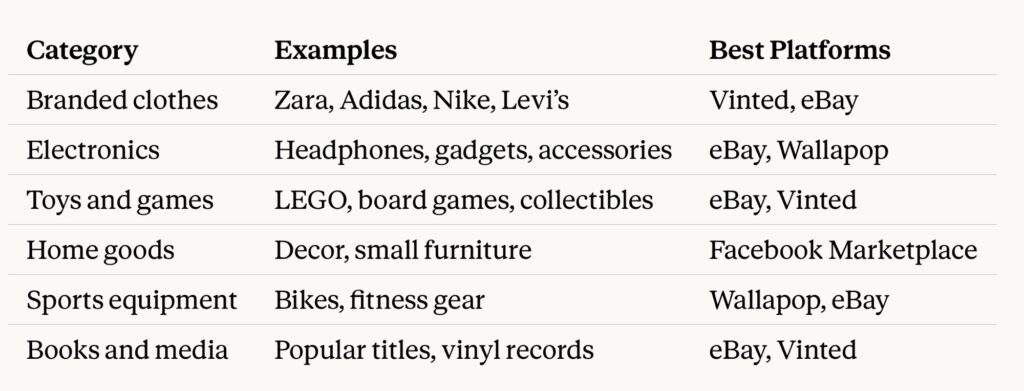
Table showing categories of resale products in Europe, including branded clothes, electronics, toys, home goods, sports equipment, and books, with examples like Zara, Nike, LEGO, and recommended platforms such as Vinted, eBay, Wallapop, and Facebook Marketplace.
For most beginners, branded clothing is the best starting point. The items are easy to find on clearance, easy to store, easy to ship, and Vinted makes selling them almost frictionless — no seller fees, large audience, simple process.
Step 2 — Find Clearance Deals
This is the part most people enjoy. You are hunting for things that are priced below their real value.
In physical stores:
- Clearance racks at Zara, H&M, and Mango are reliable starting points
- TK Maxx (known as TJ Maxx in the US) stocks discounted branded goods year-round
- Decathlon has excellent clearance on sports equipment
- Charity shops in wealthier areas often have high-quality donations priced very low
Online:
- ASOS Outlet and Zalando Lounge run online clearance sales
- Veepee and BrandAlley sell branded stock at heavy discounts
- eBay auctions — filter by “ending soon” with low bids — can surface excellent deals
- Facebook Marketplace — people often price low just to clear space quickly
One practical tip: Visit physical stores on Monday mornings. Shops often process new clearance stock over the weekend, and Monday is when those items appear on the racks. Getting there early means seeing the best selection before anyone else.
Step 3 — Check the Numbers Before You Buy
This step is non-negotiable. Never buy based on gut feeling alone. Always check the real selling price first.
Here is the process:
- Open Vinted or eBay on your phone while still in the store
- Search for the exact item — brand, model, size if relevant
- Filter by sold or completed listings (not just active ones)
- See what buyers have actually paid recently
- Subtract the platform fee and shipping cost from that number
- Compare the result to what you would pay for the item
A simple rule that works: Only buy if you can sell for at least double what you pay, after fees. Buy at €20, aim to sell for €50 minimum. Buy at €35, aim for €75 or more.
If the margin is not there, put it back. The next deal will come.
Step 4 — Buy Smart and Stay Within Budget
Set a starting budget before you go out — €30 to €50 is enough to test with. Stick to it.
When examining an item, check carefully for:
- Stains, marks, or discolouration
- Damage to zips, buttons, or stitching (for clothes)
- Missing parts or accessories (for electronics or games)
- Any smell (cigarette smoke or mould makes items very hard to sell)
A useful question to ask yourself: “Would I feel comfortable buying this at the price I plan to sell it for?” If the answer is yes, a buyer will feel the same way.
How to Use the Seasons to Your Advantage
Step 5 — Take Photos That Actually Sell
Photos are the single biggest factor in whether your item sells or sits unnoticed. A great product with bad photos will not sell. A decent product with clear, bright photos will.
You do not need a camera or studio lighting. A phone and a window are enough.
How to take good listing photos:
- Use natural light — stand near a window, avoid flash
- Use a plain background — a white wall, a light-coloured floor, or a clean surface
- Take multiple angles — front, back, label or brand tag, any flaws
- For clothes, hang them on a hanger or lay them flat — do not photograph them crumpled in a pile
- For electronics, photograph them switched on if possible, to show they work
Spend 10 minutes on photos. It is the best 10 minutes you will invest in the whole process.
Step 6 — Write a Description That Answers Every Question
A good description removes every reason for a buyer not to purchase. They should read it and know exactly what they are getting.
Keep it short and factual. Include:
- Brand and exact model name
- Size, with measurements if it is clothing (some buyers are cautious about fit)
- Condition — be specific: new with tags, like new, good, fair
- Any flaws — mention them honestly; a buyer who discovers a flaw after receiving the item will leave a bad review or request a refund
- Original retail price (optional, but it helps buyers understand the value)
Example of a good description:
“Adidas Stan Smith trainers, size EU 42. Worn twice, like new condition. No marks, no damage. Original price €90, selling for €45. Tracked shipping available. Happy to answer any questions.”
That is 30 words. It tells the buyer everything they need to know. Nothing unnecessary, nothing missing.
Step 7 — Price to Sell, Not to Dream
A common beginner mistake is pricing too high and then watching the listing sit there for weeks. Items that sell quickly generate cash you can reinvest. Items that sit cost you nothing directly, but they slow down your whole operation.
General pricing guide:
- New with original tags: 50–70% of the retail price
- Like new, no signs of wear: 40–60% of retail
- Good condition, minor signs of use: 30–50% of retail
Most buyers on Vinted and Facebook Marketplace will send an offer lower than your listed price. Price your item 10–15% above the minimum you would accept, so you have room to negotiate and both sides feel satisfied.
Step 8 — Ship Quickly and Pack Carefully
Fast shipping and good packaging lead to good reviews. Good reviews lead to more sales.
For shipping:
- Always use tracked shipping — if a buyer says they never received it, you need proof
- Pack clothes in a sealed plastic bag inside the outer packaging to protect from moisture
- Wrap electronics or fragile items in bubble wrap
- Aim to ship the next day after a sale, or the same day if possible
For local collection:
- Meet in a public place — a café, a shopping centre, a busy street
- Accept cash or payment through the platform only — never a bank transfer to a stranger
- Bring exact change if you expect cash payment
How to Use the Seasons to Your Advantage
Reselling has natural rhythms. Learning when to buy and when to sell is one of the things that separates average resellers from good ones.
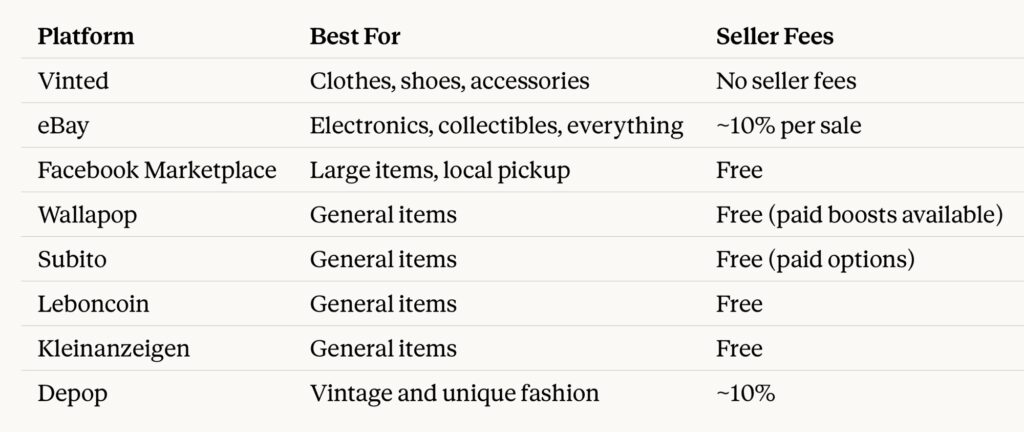
Table showing seasonal resale strategy in Europe, including what to buy and when, such as unwanted Christmas gifts in January, winter clearance in early year, summer sales, back-to-school items, Black Friday deals, and last-minute December gifts with reasons for resale timing.
The smartest seasonal move: Buy winter coats in March when shops are clearing them. Store them until October. Sell them when people suddenly need a coat and clearance racks are empty. The price difference can be significant.
Which Platforms Work Best in Europe
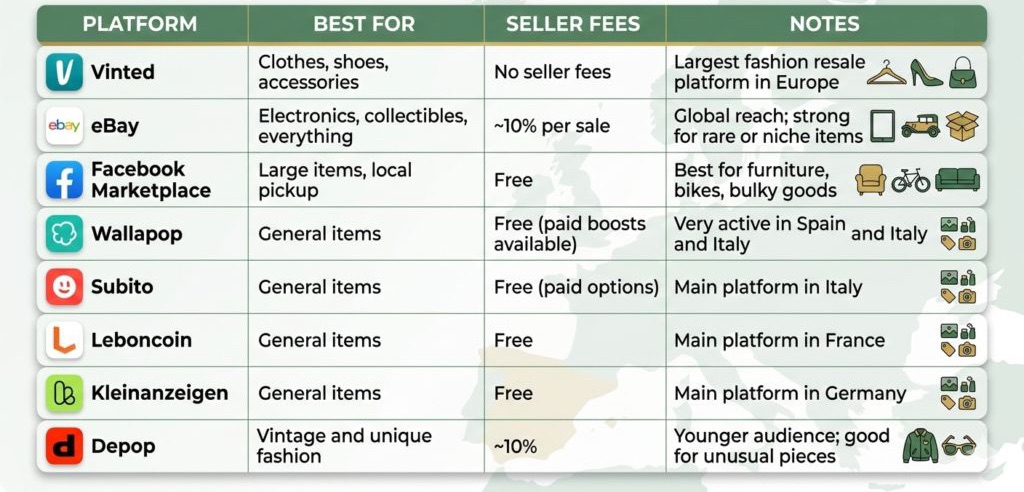
Comparison table of the best resale platforms in Europe, including Vinted, eBay, Facebook Marketplace, Wallapop, and others, with their fees, categories, and key benefits.
Practical approach: Start with Vinted if you are selling clothes — no seller fees makes it the most beginner-friendly option. Add eBay once you are comfortable, especially if you find electronics or collectibles worth flipping.
Tips to Earn More and Avoid Common Mistakes
Mistakes That Cost Beginners Money
Buying what you like, not what sells. Personal taste is not the same as market demand. Before buying, always check whether other people are buying similar items online. The question is not “Do I like this?” but “Are people paying for this?”
Checking listed prices instead of sold prices. Anyone can list an item at any price. What matters is what buyers have actually paid. Always filter by completed or sold listings before deciding a price is realistic.
Bad photos. This is the most common and most fixable problem. Dark, blurry, or cluttered photos result in no sales. Fix your photos first before changing anything else.
Forgetting to include fees in your calculations. eBay takes around 10%. Shipping costs money. PayPal or other payment processors may take a small cut too. Calculate your real profit after all costs — not just the sale price minus the buy price.
Slow communication. When a buyer sends a question or an offer, reply the same day. Slow responses send buyers to the next listing. Most resale platforms show buyers when a seller was last active.
Poor packaging. A damaged item arriving means a refund Comparison table of the best resale platforms in Europe, including Vinted, eBay, Facebook Marketplace, Wallapop, and others, with their fees, categories, and key benefits.request, a bad review, and a wasted sale. Packaging is not a place to save money.
Trying to sell everything at once. Spreading yourself across six categories, five platforms, and twenty items simultaneously as a beginner is overwhelming. Pick one category, one or two platforms, and master those first.
Tips to Improve Your Results
Bundle related items. Three shirts sold together for €40 earn more per listing than three separate €15 sales — and require only one shipping transaction. Buyers feel they are getting a deal; you save time and effort.
List at peak times. New listings receive the most visibility in their first 24 hours. List on weekday evenings (7–9pm) and on weekends when more people are browsing.
Accept offers strategically. Most buyers on resale platforms expect to negotiate. Price 10–15% above your minimum and welcome offers. A quick, friendly response to an offer — even a counteroffer — converts more buyers than a flat refusal.
Track every transaction. Keep a simple spreadsheet: what you bought, what you paid, what you sold it for, platform fees, shipping cost, and net profit. After a month, you will know exactly which categories, platforms, and types of items are working best for you.
Study what sells well in your niche. Spend 20 minutes looking at completed listings in your category. Notice what the best-performing listings have in common — photo style, description length, pricing patterns. Learn from sellers who are already succeeding.
Think ahead with seasons. The resellers who earn the most are not just reacting to today’s market. They are buying summer stock in August and winter stock in March, ready to sell when demand peaks.
What Sells Best Across Europe
Always in demand, year-round:
- Nike and Adidas — especially classic styles like Air Force 1, Stan Smith, Gazelle
- Zara — consistently popular across all European markets
- Apple accessories — AirPods, Watch bands, cases
- LEGO — retired sets especially; LEGO holds and often increases in value
- Gaming — PlayStation, Xbox, and Nintendo consoles and games
- Vintage fashion — 90s and early 2000s clothing, denim, vinyl records
Seasonal demand:
- Winter coats and knitwear (September–February)
- Summer dresses, shorts, and swimwear (April–August)
- Halloween costumes (October)
- Christmas decorations and gift sets (November–December)
Easiest to store and ship:
- Clothes and accessories (light, foldable, low breakage risk)
- Small electronics and accessories
- Books and records
- Jewellery and watches
More difficult to handle as a beginner:
- Furniture and large items (hard to ship; local collection only)
- Fragile glassware or ceramics (high breakage risk)
- Items without original packaging (electronics especially)
What Can You Realistically Earn?
Here is an honest breakdown based on how much time and effort you put in:
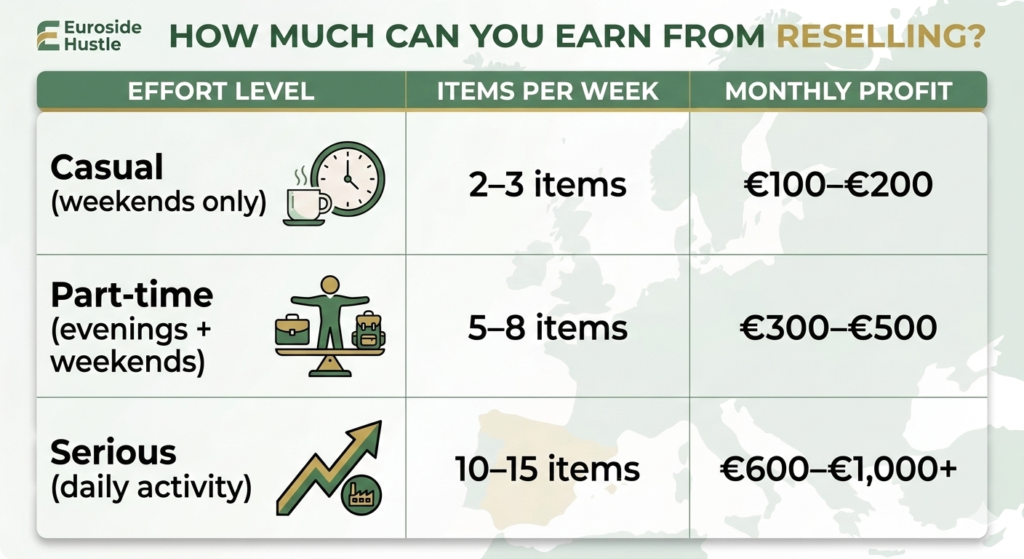
Table showing resale income potential based on effort level, from casual weekend selling to full daily activity, with estimated monthly profits in euros.
Most people who try reselling seriously for the first time earn €100–€200 in their first month. That is not a salary. But it is real money, earned from a skill that grows with practice — and it pays for flights, groceries, or whatever matters most to you right now.
and Now, What to do Next?
Reselling is one of the most accessible ways to make extra money in Europe. No special qualifications. No expensive startup costs. No waiting months to see results.
The model is simple: find something undervalued, sell it to someone who wants it, keep the difference.
What makes people successful at this is not secret knowledge — it is consistency. Checking the numbers before buying. Taking decent photos. Pricing fairly. Shipping quickly. And doing it again.
Here is your starting point for this weekend:
- Choose one category — clothing is the easiest to begin with
- Visit one store with a clearance section — TK Maxx, Zara, Decathlon, or a local charity shop
- Find one item with a clear profit margin — check sold prices on your phone before buying
- List it on Vinted or eBay with natural-light photos and a clear description
- See what happens
One item. Low risk. A real lesson in how this works.
The clearance racks are there every weekend. The buyers are already on the platforms. The only thing missing is someone willing to connect the two.
That someone can be you.
What is the best deal you have ever found? Drop a comment — great flip stories are always welcome.
EuroSideHustle helps people in Europe — including immigrants and beginners — build real income online. Explore more guides at EuroSideHustle.com.