
How to Make Money on Medium in Europe
The Definitive Guide for Beginners
This post may contain affiliate links. We may earn a commission at no extra cost to you.
The Problem Most Beginners Face
You want to make money writing online, but every option feels complicated.
Starting a blog means buying a domain, setting up hosting, learning WordPress, figuring out SEO, and waiting months before a single person reads your work. It is expensive, technical, and slow.
Meanwhile, you already know how to write. You have ideas, opinions, and knowledge worth sharing. You just need a place to do it — a place that already has readers.
That is exactly what Medium offers. And in this guide, you will learn exactly how it works, how writers get paid, and how to start from zero as someone living in Europe.
What Is Medium and How Does It Work?
A Clear Definition
Medium is an online publishing platform. It was founded in August 2012 by Ev Williams, one of the co-founders of Twitter. His goal was to create a space for longer, more thoughtful writing — content that goes deeper than a tweet.
The simplest way to understand Medium is this: it is part blog, part social network. You write and publish articles, and readers discover them through the platform. No website to build. No hosting to pay for. No technical setup required.
The Numbers Behind the Platform
Medium has over 100 million monthly readers. That audience already exists when you sign up. You do not need to build it from scratch — you just need to write content that connects with people already browsing the platform.
How Readers Find Your Articles
Medium uses two main systems to distribute content:
1. An algorithm — Medium tracks topics, tags, and reading behaviour. When you write about a specific subject and use relevant tags, the algorithm suggests your article to readers who follow that topic.
2. Human curators — Medium has a team of editors who can give an article a “Boost.” This means they select it and push it to a much larger audience. A Boost can turn a brand-new writer’s article into a viral piece overnight.
This combination means that even with zero followers, a well-written article can reach thousands of readers.
How Medium Makes Money
Medium operates on a subscription model. Non-members can read a limited number of articles per month for free. Members pay €5.49 per month (or €50.99 per year) for unlimited access. That subscription money is then distributed to writers based on how much time members spend reading their stories.
This is important to understand: you are not paid per click or per view. You are paid based on genuine engagement from paying readers.
Why Medium Is Worth Considering for Europeans
Before looking at the steps, it helps to understand why Medium is specifically a good option for people in Europe — including immigrants and non-native English speakers.
The Practical Benefits
No technical skills needed. The editor is clean and simple. You write, you publish. That is it.
No upfront cost. Creating an account and publishing is completely free.
Built-in audience. You do not spend months waiting for Google to discover your site.
Works across Europe. Writers in most European countries can join the paid Partner Programme, as long as their country is supported by Stripe (the payment processor Medium uses).
Language flexibility. While most high-traffic content is in English, the platform does not restrict you by location or nationality.
No visa or work permit issues. You are earning from a content platform, not from an employer. This can be relevant for immigrants navigating work restrictions.
Medium vs. Starting Your Own Blog
Here is a direct comparison so you can decide what fits your situation:
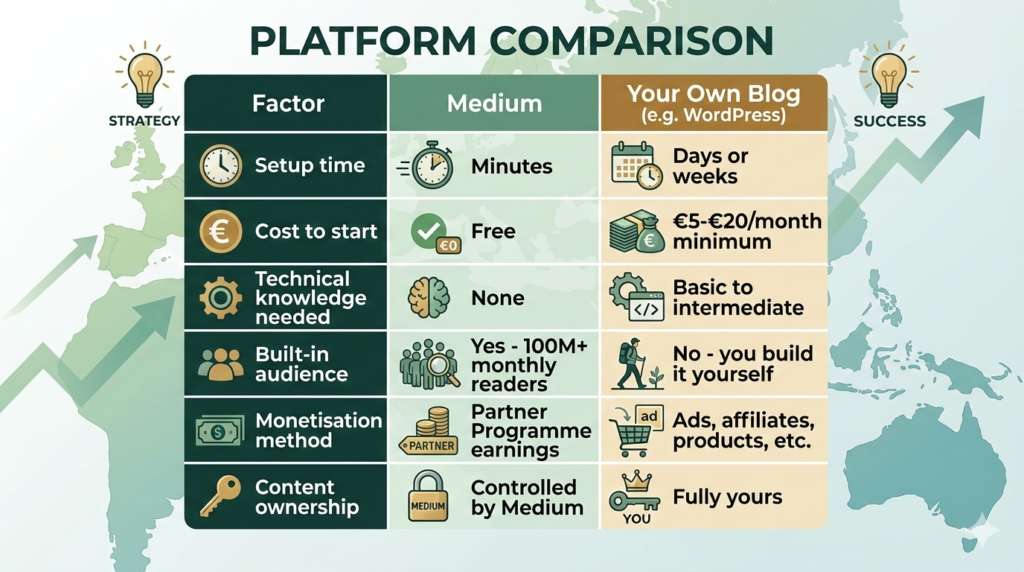
Comparison chart between Medium and a personal blog like WordPress, showing differences in setup time, cost, technical skills, audience, monetisation, and content ownership.
The honest verdict: Medium is the better starting point if you want to test writing online with no money and no technical knowledge. A personal blog gives you more long-term control and more ways to earn, but it requires more work and investment upfront.
Many successful writers use both — they build their audience on Medium and then redirect that audience to their own site or email list.
Step-by-Step: How to Start on Medium
Step 1 — Create Your Account
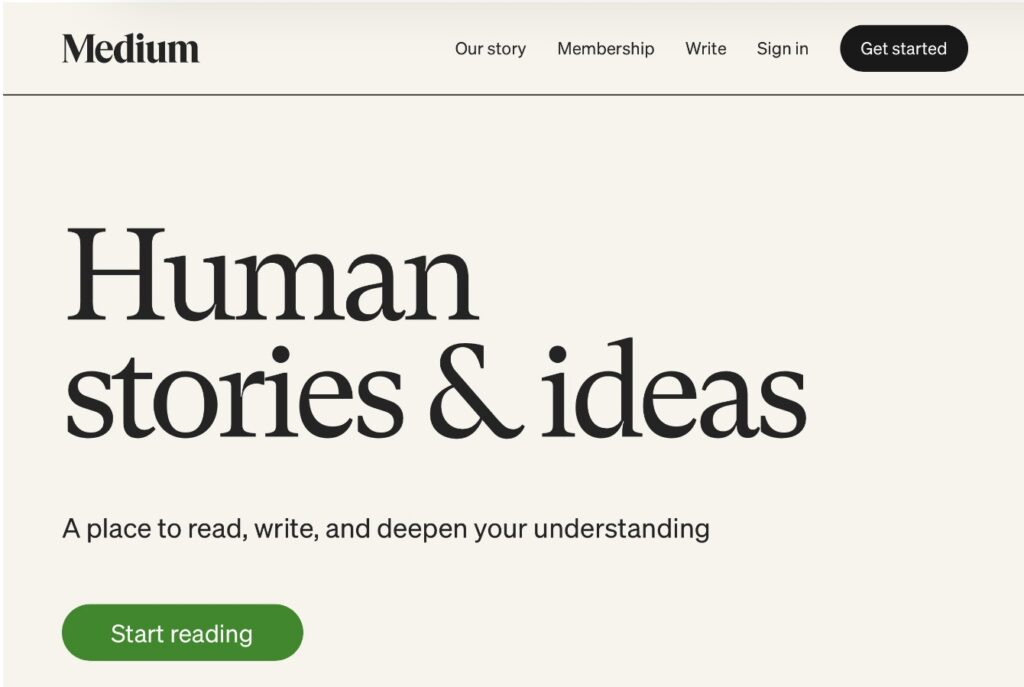
Screenshot of Medium homepage showing navigation menu with ‘Our story’, ‘Membership’, ‘Write’, and ‘Sign in’, along with the headline ‘Human stories & ideas’ and a call-to-action ‘Start reading’.”
Go to medium.com and click “Get Started.” You can sign up using your email address, Google account, Facebook, or Twitter. The process takes about two minutes.
Practical tip: Use a Google account if you have one. It makes the sign-up process faster and you can always change your display name later.
Step 2 — Set Up Your Profile Properly
Once you are inside, go to your profile settings and fill in three things:
Profile photo: Use a clear, professional-looking photo of your face. Readers trust real people more than blank avatars.
Bio: Write two to three sentences about who you are and what you write about. Be specific. “I write about personal finance and freelancing for Europeans living abroad” is better than “I love writing.”
Links: Add links to your social media, website, or email newsletter if you have them. This turns readers into followers across platforms.
Practical tip: Include one relevant keyword in your bio. For example, if you write about remote work, include the phrase “remote work” naturally in your bio text. This helps Medium’s algorithm understand your focus.
Step 3 — Understand the Editor Before You Write
Click “Write a story” in the top right corner. You will see a clean, distraction-free writing space. It works like a simple document editor — you type your title, then your content below it.
The editor supports:
– Images — uploaded directly or linked from the web
– Videos — embedded from YouTube
– Audio — embedded from Spotify
– Bold and italic text
– Subheadings (H1, H2, H3 style)
– Bullet points and numbered lists
– Separators (horizontal lines to break up sections)
– Code blocks (useful for technical articles)
All drafts are saved automatically. You will never lose your work.
Practical tip: Write your first draft without worrying about formatting. Get your ideas down first, then go back and add headings, images, and structure.
Step 4 — Write Your First Article
For your first article, choose a topic you genuinely know something about. This does not need to be a professional qualification. It can be:
– Something you learned from personal experience (moving to a new country, finding work online, learning a language).
– A skill you have developed (cooking, budgeting, photography, coding).
– An opinion or observation backed by real examples
Format your article correctly:
– Use a clear, specific title. “How I Saved €200 Last Month Using One Simple Budgeting Method” performs better than “Tips for Saving Money.”
– Write short paragraphs — two to four lines maximum.
– Use subheadings to break up sections every 200–400 words.
– Include at least one image (the cover image matters — it is what readers see before clicking).
– Aim for at least 800–1,200 words for your first articles. Longer content tends to earn more because it generates more reading time.
Practical tip: Start your article with a real problem, not a general introduction. Readers decide in the first five seconds whether to keep reading. Give them a reason to stay immediately.
Step 5 — Add Tags Before Publishing
Before publishing, Medium asks you to add tags. You can add up to five tags per article.
Tags are how readers discover your content. Choose tags that accurately describe your article’s topic. For example, an article about freelancing in Spain might use tags like: Freelancing, Remote Work, Europe, Side Hustle, Online Business.
Practical tip: Check how many followers each tag has before choosing. Tags with between 10,000 and 100,000 followers are often the best balance — large enough to have readers, small enough that your article does not disappear in a flood of new posts.
Step 6 — Submit to a Publication
A Publication on Medium works like a themed magazine. Each one has its own editors, its own style guidelines, and — most importantly — its own audience of followers.
When you publish directly to your profile, your article is only visible to your followers plus whoever the algorithm reaches. When you publish through a Publication, you instantly access that publication’s entire follower base.
How to submit:
- Search Medium for publications in your topic area (for example, search “personal finance publication” or “side hustle writers”).
- Go to the publication’s page and look for a “Write for us” or “Submissions” page.
- Follow their instructions — most will ask you to email the editors your Medium account ID so they can add you as a contributor.
- Once accepted, go to your draft, click the three dots menu at the top, and select “Add to Publication.”
Practical tip: Start by submitting to one large general publication (such as ILLUMINATION, which accepts many topics) and one smaller, niche publication with 1,000–5,000 followers. In a smaller publication, your article is less likely to get buried.
Step 7 — Apply for the Partner Programme
The Partner Programme is what makes Medium a real income source, not just a writing platform.
To be eligible in early 2026, you must:
– Be a paying Medium member yourself (€5.49 a month)
– Have published at least 5 stories in the last 6 months
– Be at least 18 years old
– Live in a country that supports Stripe payments — this includes most of the EU, the UK, Switzerland, Norway, and other European countries
Once accepted, every article you publish can earn money. You do not need to do anything extra — the earnings happen automatically based on how members engage with your writing.
Practical tip: The €5.49/month membership fee to join is your only real cost on Medium. Think of it as an investment in your ability to earn from the platform.
How Exactly Do You Earn Money on Medium?
Understanding the earning system helps you make smarter decisions about what and how to write.
The Four Earning Factors
1. Member reading time
This is the most important factor. You earn when a paying Medium member spends 30 seconds or more reading or listening to your story. The longer they stay, the more you earn from that single reading session.
This means a 1,500-word article that genuinely holds someone’s attention earns more than a 300-word article that gets skimmed and abandoned.
2. Positive interactions
Claps (Medium’s equivalent of likes), highlights, and comments signal to the algorithm that readers found your article valuable. These interactions also contribute to your earnings. Claps can be given up to 50 times per reader per article, so a highly engaged reader has more impact than a passive one.
3. Follower bonus
If your existing followers engage with your article, you receive a small bonus. This rewards writers who build a loyal readership over time, not just those who go viral once.
4. Boost bonus
If a Medium curator selects your article for a Boost, it is distributed to a much wider audience. A Boosted article can earn significantly more than a non-Boosted one. You cannot request a Boost directly — it happens when the quality of your writing earns it.
What Can You Realistically Expect to Earn?
This is where honesty matters.
The majority of writers on the Partner Programme earn small amounts — a few dollars per month when starting out. Data shared within the writing community suggests that around only 6% of active Partner Programme writers earn more than $100 in a given month.
One experienced Medium writer described their experience this way: earnings of roughly $5,000 came over two to three years, with nearly half from a single viral article. Most articles earned only cents.
This is not discouraging — it is realistic. Medium is not a get-rich-quick tool. It is a long-term platform where consistent, quality writing builds real income over time. Some writers do reach $1,000+ per month, but that typically comes after one to two years of publishing regularly.
Other Ways to Earn Using Medium
The Partner Programme is not the only way Medium makes you money. Many of the platform’s most successful writers treat it as a springboard, not the final destination.
Use Medium as a Freelance Writing Portfolio
A strong collection of well-written Medium articles is a professional portfolio. Clients searching for writers can see your style, your quality, and your ability to explain complex topics clearly. Many European freelance writers have landed €300–€1,000 writing contracts from clients who discovered them through Medium first.
Promote Your Own Products or Services
At the end of your articles, you can include a short, natural call to action pointing readers toward:
– An online course you sell
– An e-book on a relevant topic
– A consulting service or coaching offer
– A digital product (templates, guides, spreadsheets)
Important: The call to action must feel relevant to the article. Readers are smart — they respond to genuine recommendations and ignore obvious sales pitches.
Build an Email List
Medium gives you the ability to add a link to any email list sign-up page. This is one of the most valuable things you can do as a writer. An email subscriber is someone you can contact directly — you are not dependent on Medium’s algorithm to reach them.
Offer a free resource (a checklist, a mini-guide, a template) in exchange for their email address. Over time, that list becomes an asset you own and control, regardless of what happens to Medium.
Common Mistakes to Avoid

Mistake 1 — Publishing Once and Waiting
Many beginners publish one or two articles, see low earnings, and give up. The Medium algorithm rewards consistent writers. One article cannot build momentum. Aim for at least one article per week for three months before evaluating your results.
Mistake 2 — Writing Only for the Algorithm
Some new writers chase popular topics without genuine interest or knowledge. Readers can sense when an article is hollow — and hollow articles get skimmed, not read. Low reading time means low earnings. Write about what you actually know.
Mistake 3 — Ignoring the Cover Image
The cover image is the first thing a reader sees when browsing. A blurry, generic, or irrelevant image tells readers your article is low effort before they even read the title. Use free tools like Unsplash (for free high-quality photos) or Canva (for designed images) to create a professional-looking cover.
Mistake 4 — Skipping Tags or Using Wrong Tags
Tags with millions of followers (like “Life” or “Writing”) are so competitive that new writers’ articles disappear instantly. Tags with zero followers reach no one. Research medium-sized tags relevant to your topic.
Mistake 5 — Treating Each Article as Standalone
The most successful Medium writers build a connected body of work. Reference your older articles in new ones. Build a series around a theme. This encourages readers to stay on your profile longer and follow you for more.
Tips to Improve Your Results
Write evergreen content — articles that remain relevant for months or years perform better over time because they continue accumulating reading time. “How to Save €500 in 30 Days” will keep earning long after a trend-chasing article becomes irrelevant.
Read other writers in your niche — leave thoughtful comments on their articles. This gets your name in front of their audience and builds genuine connections within the Medium community.
Study your Medium Stats — Medium gives you a dashboard showing views, reads, read ratio, and earnings per article. A low “read ratio” (people who start reading but stop) is a sign your opening paragraphs are not strong enough.
Republish strategically — Medium allows you to import articles from other platforms. If you have a personal blog, you can publish there first, then import to Medium a few weeks later for a second wave of readers.
Write for readers, not for applause — the writers who earn the most are those who genuinely help people, challenge their thinking, or make them feel understood. Ask yourself before publishing: “Does this article give the reader something real?”
And , What to Do Next?
Medium is a legitimate platform for earning money through writing. It is not a quick income source — but it is one of the most accessible ways to start earning online, especially if you are in Europe, have limited budget, or are new to building income online.
The reality is that most writers earn small amounts in the beginning. Growth is slow and gradual. But the writers who stay consistent, publish regularly, and focus on quality do see results over time.
Here is your clear next step:
- Create a free Medium account today.
- Write and publish your first article this week — on any topic you genuinely know.
- After publishing five articles, apply for the Partner Programme.
- Set a goal: one article per week for 90 days.
After 90 days, you will have a real body of work, a growing audience, and a much clearer picture of how this income source fits your life.
The page is blank. The audience is waiting. The only thing left is to start.
EuroSideHustle helps people in Europe — including immigrants and beginners — build real income online. Explore more guides at EuroSideHustle.com