
How to Make Money Online Europe: Rent Small Spaces
Complete Beginner’s Guide
This post may contain affiliate links. We may earn a commission at no extra cost to you.
The Spare Room That Was Just Sitting There
In 2019, a two-bedroom apartment in Dublin. Roommate moved out. Suddenly responsible for the full rent alone.
Stressful. Really stressful.
A Brazilian friend named Carlos had a simple suggestion: “List it on Airbnb.”
That felt absurd. One spare room? Who would want that?
“Tourists,” he said. “Students. People on short courses. Dublin is expensive. People want cheaper options.”
Skeptical, but also desperate.
That weekend: a few photos, a short description, published on Airbnb at €45 per night. The first booking arrived within a week — a German student in Dublin for a two-week English course. Fourteen nights. €630.
The room had been sitting empty. Now it was paying the rent.
That is the idea behind micro-rentals. You do not need a hotel. You do not need to own a whole apartment building. You just need a small space that someone else needs — and the knowledge to connect the two.
This guide will walk you through everything: what kinds of spaces you can rent, which platforms to use, how to set it up, what you can realistically earn, and how to avoid the mistakes that cost beginners money.
What Are Micro-Rentals?
Micro-rentals means renting out a small space you already have — not a whole property investment, not a real estate business, just a room, a garage, a parking spot, or even a storage corner — to people who need it.
The idea is simple. You have space. Someone else needs space. They pay you to use it.
What makes this different from traditional property rental is the scale. You are not buying a second apartment. You are not becoming a landlord in the traditional sense. You are using what you already have — space that would otherwise sit unused — and turning it into income.
This can be as small as renting a corner of your attic to a student needing storage, or as significant as renting your spare bedroom to tourists on Airbnb every weekend.
The key word is small. Small space. Small start. Real income.
What Kinds of Spaces Can You Rent?
There are more options than most people realise. Here are the main categories, with realistic examples from across Europe.
1. Spare Bedrooms
This is the most common starting point, and probably the most lucrative for the space involved.
Short-term (Airbnb style):
Ideal for tourists, business travellers, and people between apartments. You earn more per night but the work is higher — cleaning between guests, managing check-ins, keeping supplies stocked.
- Typical earnings: €30–€80 per night, depending on city and room quality
Long-term (roommate style):
Ideal for students and young professionals who need somewhere to live for several months. Lower monthly income than short-term, but far less work — one guest, one contract, consistent payment.
- Typical earnings: €400–€800 per month, depending on city
Many people do both: short-term in summer when tourist demand is high, long-term from September to May when students need housing.
2. Entire Small Apartments
If you own or rent a small apartment and can stay elsewhere temporarily — with family, a partner, or a friend — you can rent your whole home during that period.
A real example: a friend in Lisbon visits her family in Porto for ten days every month. While she is away, her one-bedroom apartment is listed on Airbnb at €80 per night. Those ten nights bring in €800. Her monthly rent is €700. She effectively lives for free.
3. Storage Space
This one surprises most people. Demand for storage in European cities is enormous — apartments are small, people have too much stuff, and professional storage facilities are expensive.
What you can rent out:
- A garage or part of a garage
- An attic
- A basement or cellar
- A large cupboard or spare wardrobe
- A locked shed
Platforms for storage rentals: Stashbee (UK and parts of Europe), Neighbor, local Facebook groups
Typical earnings:
- Parking space: €50–€100/month
- Garage: €150–€300/month (in cities like Berlin, Paris, or Amsterdam)
- Attic or basement space: €60–€150/month
This is one of the most passive forms of rental income available. Once a renter moves their belongings in and the contract is signed, there is very little ongoing work.
4. Parking Spaces
In European city centres, parking is scarce and expensive. If you have a parking spot and can use public transport or a bike instead, renting that spot can generate reliable monthly income with almost zero effort.
In central areas of cities like London, Paris, Amsterdam, or Dublin, a single parking space can earn €100–€250 per month.
5. Garden or Outdoor Space
Less common, but possible in some situations:
- Rent a section of a large garden to someone who wants to grow vegetables (allotment-style)
- Rent your accessible driveway or courtyard as parking
- Rent the outdoor space for small private events
This depends heavily on your specific situation, but it is worth considering if you have underused outdoor space.
6. Daytime Home Office or Studio Space
Remote work has created a new type of demand: people who work from home but find it difficult to concentrate there. A quiet, separate room — even rented by the day or week — has real value to freelancers, writers, or small business owners.
This works particularly well if your spare room has a desk, good lighting, and strong Wi-Fi.
Why Micro-Rentals Are Worth Considering
There are several practical reasons why this approach suits people in Europe, especially those building income on the side.
You start with what you already have. Most side hustles require buying something, creating something, or learning a new skill from scratch. Micro-rentals use space you already own or rent. The barrier to entry is extremely low.
The income can be highly passive. A storage renter signs a six-month contract and essentially disappears. A long-term roommate pays monthly with minimal interaction. Even short-term Airbnb hosting, once the systems are set up, runs largely on autopilot.
Demand is reliable and structural. Hotels in major European cities are expensive. Housing is expensive. Storage is expensive. These are not trends — they are long-term realities of European city life. The demand for affordable alternatives is not going away.
You can scale gradually. Start with one parking space or one storage listing. Learn the process. Then add more spaces as you become comfortable.
The income is real and immediate. Unlike some online income models where it takes months to see results, a well-priced room in a popular city can earn money in the first week.
Step-by-Step: How to Start Renting Your Space
Step 1 — Identify What You Have
Walk through your home and look at it with a fresh perspective. Ask yourself:
- Is there a bedroom I do not use regularly?
- Is my garage being used for storage I could consolidate or move?
- Do I have an attic or basement that is mostly empty?
- Could I park my car on the street and rent my parking spot?
- Is my garden bigger than I need?
- Do I have a spare room that could serve as an office space during weekdays?
Be honest about what is actually usable. An attic full of boxes requires work to clear. A garage with a broken door needs a repair. Factor that effort into your decision.
Step 2 — Check the Rules for Your City
This step is critical and often skipped by beginners. Rules vary significantly between European cities, and the consequences of getting this wrong can be serious.
What to research:
- Short-term rental limits: Some cities cap how many nights per year you can rent on platforms like Airbnb without a commercial licence. Amsterdam allows 30 nights per year. Barcelona requires a specific tourist apartment licence that is very difficult to obtain. Paris has strict registration requirements.
- Registration requirements: Some cities require you to register as a short-term rental host and display a registration number on your listing.
- Tax rules: Rental income is taxable income in virtually every European country. The thresholds and rates vary, but you need to understand your obligations from the beginning.
- Building regulations: If you rent in a building with shared ownership (a co-op or residents’ association), check whether your contract or building rules permit subletting.
- Lease restrictions: If you rent your own apartment, check whether your tenancy agreement allows you to sublet any part of it.
How to find this information:
Your city’s official website is the most reliable source. Search for “short-term rental rules” plus your city name. For practical, ground-level advice — including what actually happens in practice — join Facebook groups for Airbnb hosts or local landlords in your area. Other hosts in your city will know exactly what the current situation is.
Step 3 — Prepare Your Space
First impressions determine bookings. A clean, well-presented space earns more than a messy one at the same price.
For rooms and apartments:
- Deep clean before listing — floors, bathroom, kitchen, windows
- Fix any minor issues: broken handles, flickering lights, dripping taps
- Provide the basics: fresh sheets, clean towels, functional Wi-Fi, a spare set of keys
- Add small touches that cost almost nothing but generate positive reviews: a welcome note, a printed list of local restaurant recommendations, a phone charger by the bed
For storage spaces:
- Clear out anything that belongs to you
- Make sure the space is dry — moisture damages stored items and creates liability issues
- Install a proper lock if one is not already there
- Make sure the renter can access the space easily and safely
For parking spaces:
- Clearly mark the space if it is within a shared car park
- Confirm the dimensions so the renter knows their vehicle will fit
- Make sure access is clearly explained (barrier code, key fob, etc.)
Step 4 — Choose Your Platform
Different spaces suit different platforms. Here is a practical overview:
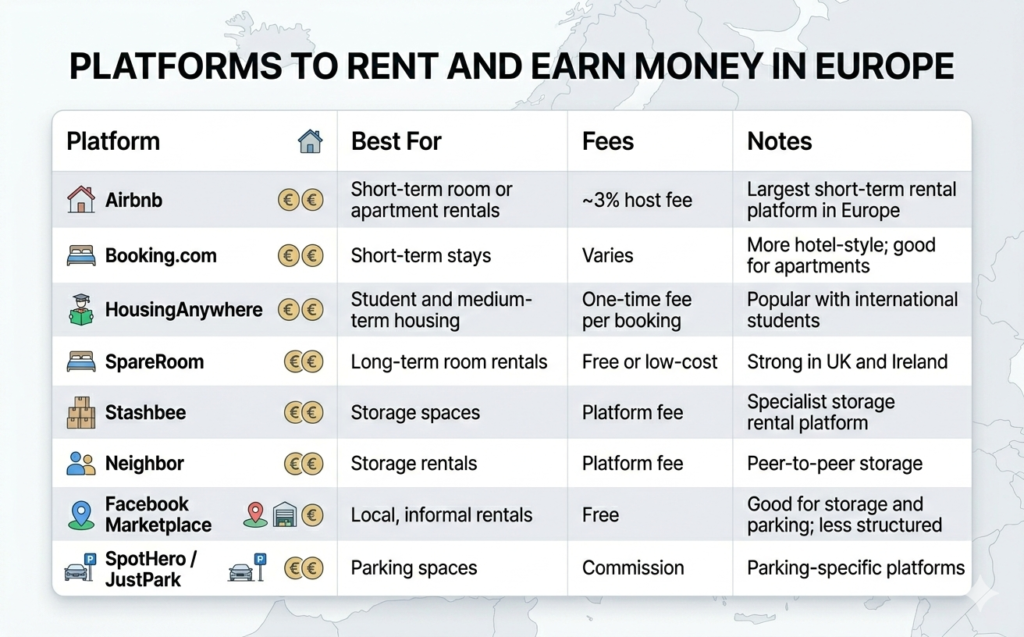
Comparison table of rental platforms in Europe showing Airbnb, Booking.com, HousingAnywhere, SpareRoom, Stashbee, Neighbor, Facebook Marketplace, and JustPark, with details on best use, fees, and key features for earning money online.
Practical advice for beginners: Start with one platform. Learn how it works, get your first reviews, and build confidence before listing on a second platform. Managing multiple platforms at once without experience leads to double bookings and missed messages.
Step 5 — Create a Listing That Fills Your Calendar
Your listing is your advertisement. A great listing with good photos and a clear description will consistently outperform a vague listing with dark photos — even if the space itself is identical.
Photos first. On every rental platform, photos are the first thing a potential guest or renter sees. Poor photos mean no bookings, regardless of how good the space is.
How to take good listing photos:
- Use natural light — open curtains and blinds, turn off artificial lights, shoot near windows
- Shoot the room tidy and staged — make the bed, clear surfaces, put away clutter
- Take multiple angles: the full room from the doorway, the bed, the desk, the bathroom, the view if there is one
- For storage and garages, show the full space, the lock, and the access point
Write a description that answers every question.
A guest about to book has specific concerns. Your description should address them before they need to ask:
- What exactly is the space? (room, garage, parking spot)
- What is included? (furniture, Wi-Fi, parking, towels)
- Where is it located? (neighbourhood, distance to transport or tourist areas)
- What are the house rules? (quiet hours, smoking policy, guests)
- How does access work?
Here is an example of a listing description that works:
“Quiet spare room in Dublin city centre. Double bed, work desk, and fast Wi-Fi. Ten minutes’ walk to Temple Bar and five minutes to the bus stop. Shared bathroom with the host. I work during the day, so you’ll have plenty of privacy. Clean towels and fresh sheets provided. No smoking, no parties. I’m happy to share local tips and restaurant recommendations.”
It is clear. It is specific. It sets expectations. It says something about the host. That kind of listing builds trust before the booking is even made.
Step 6 — Price Your Space Correctly
Pricing too high means an empty calendar. Pricing too low means leaving money behind — and sometimes signals low quality to potential bookers.
How to find the right price:
- Open Airbnb, Stashbee, or whichever platform you are using
- Search for similar spaces in your exact area
- Note the prices of comparable listings — similar size, similar condition, similar location
- Start your price 10–15% below the average for your first month
- Once you have five or more positive reviews, raise your price to market rate or slightly above
Rough price guide:
- Spare room, budget city or suburb: €25–€40 per night
- Spare room, major city centre: €40–€70 per night
- Small apartment, popular tourist city: €60–€120 per night
- Storage garage, city location: €100–€300 per month
- Parking space, city centre: €50–€200 per month
Many platforms offer an automatic pricing tool that adjusts your price based on demand in your area. Airbnb’s Smart Pricing, for example, raises your rate automatically when demand is high and lowers it when bookings are slow. This is worth using once you understand your local market.
Step 7 — Manage Guests and Reviews
For short-term rentals, the guest experience determines your reviews. Reviews determine your future bookings. This is a chain worth investing in.
Respond to messages quickly. Most booking platforms show guests how responsive a host is. A slow reply rate shows up in your profile and reduces bookings. Aim to respond within a few hours at most — faster if possible.
Be clear about check-in. Send detailed instructions before the guest arrives: where the key is, how the lock works, where to park, what the Wi-Fi password is. Remove every possible point of confusion.
Address problems immediately. If something goes wrong — a broken appliance, a noise issue, a missing item — respond quickly and solve it. A guest who had a small problem that was resolved quickly often leaves a better review than a guest who had no problems at all.
Ask for reviews politely. At the end of a stay, send a short message thanking the guest and let them know you have left them a review. Most platforms show that you have reviewed them, which encourages them to review you in return.
Tips to Earn More and Avoid Common Mistakes
Mistakes That Hurt Beginners
Not checking local laws first. This is the most serious mistake. A host in Barcelona rented her flat without knowing that short-term rentals without a licence are illegal there. The fine was significant. The stress was worse. Spend an hour researching your city’s rules before you list anything.
Bad photos. Dark, cluttered, or blurry photos are the fastest way to get no bookings. This is completely fixable. Good lighting and a tidy room are all you need. The photos take 20 minutes to improve and can double your bookings.
No written house rules. “Quiet after 10pm” needs to be in your listing, not assumed. Clear rules prevent problems and give you something to point to if a guest ignores them.
Slow replies to messages. Guests compare multiple listings at once. If you reply in two days, they have already booked somewhere else. Aim for same-day responses at all times.
Not saving for tax. Rental income is taxable in every European country. If you earn €500 per month from a spare room and spend all of it, you will have a problem at tax time. Set aside 20–30% of every rental payment into a separate pot from the beginning.
Overestimating occupancy. A room will not be booked 30 nights every month. Plan conservatively — 15 to 20 nights is more realistic in most cities. Build your financial plan around that, not the best-case scenario.
Ignoring maintenance. A dripping tap or a broken blind is easy to fix when you notice it. Ignored for six months, small issues become expensive problems — and guests notice them and mention them in reviews.
Tips to Improve Your Results
Use seasonal pricing. Tourist demand peaks in summer, student demand peaks in September, conference traffic varies by city. Raise your prices during high-demand periods and lower them slightly during slow months to maintain occupancy. Most platforms help you do this automatically.
Aim for Superhost status on Airbnb. Airbnb’s Superhost badge increases your visibility in search results and builds trust with new guests. To qualify, you need a high response rate, very few cancellations, strong reviews, and a minimum number of stays per year. It is achievable within six months of consistent hosting.
Add small details that get mentioned in reviews. A small welcome basket with tea, coffee, and biscuits costs €5 and gets mentioned in positive reviews far more than its actual value. A printed list of local restaurant recommendations costs nothing and makes guests feel looked after. These small touches improve reviews, and better reviews mean more bookings at higher prices.
Consider co-hosting if you travel often. A co-host manages check-ins, cleaning coordination, and guest messages on your behalf for a percentage of earnings — usually 15–20%. If you are away frequently or simply do not want to manage the day-to-day, this keeps the income flowing without the work.
List on more than one platform once you are comfortable. More platforms mean more visibility and more bookings. Block your calendar on one platform when booked on another to avoid double bookings. This takes a little coordination but is manageable once you are used to the process.
Keep proper records. Track every rental payment, every expense related to the rental (cleaning products, repairs, platform fees, a portion of utilities), and every platform payout. This makes tax time straightforward and may reduce your taxable income through legitimate deductions.
Safety and Legal Basics
Insurance. Standard home insurance usually does not cover damage caused by paying guests. Check with your insurance provider whether your current policy covers short-term rentals, or whether you need a specific policy. Airbnb provides some host protection through their own programme, but read the terms carefully — the coverage has limitations.
Deposits. Always collect a deposit through the platform, not in cash. Platforms hold deposits and manage disputes. Cash deposits are almost impossible to recover if something goes wrong.
Guest screening. Booking platforms do basic identity verification, but trust your instincts. If an enquiry message feels unusual, if someone refuses to book through the platform and asks to pay directly, or if requests seem unreasonable before the booking is even confirmed — it is always acceptable to decline.
Written agreements. For long-term room rentals and storage contracts, always use a written agreement. Most platforms provide a standard template. For arrangements made through Facebook or locally, use a simple written contract that covers the rental price, payment schedule, access arrangements, and notice period.
and Now, What to Do Next?
Micro-rentals are one of the most accessible income sources available to people in Europe. No special skills. No products to create. No audience to build. Just a space someone else needs.
The first step is the simplest one: walk through your home today and ask what is sitting unused. A spare bedroom. A garage. An attic. A parking space.
Then spend 30 minutes researching the rules in your city, 30 minutes setting up a listing, and see what happens.
Even €100 or €200 per month from a space that was earning nothing is meaningful. It covers groceries, or a phone bill, or a flight home. And the skills you build — managing guests, pricing strategically, reading platform algorithms — compound over time into something much larger.
You do not need a hotel. You do not need a property portfolio.
You just need a little space someone else needs, and the knowledge to connect the two.
What space are you thinking of renting? Questions about how the rules work in your country? Drop a comment — let’s work through it together.
EuroSideHustle helps people in Europe — including immigrants and beginners — build real income online. Explore more guides at EuroSideHustle.com.