
How to Make Money Online in Europe With Creative Hobbies
No Freelancing Needed
This post may contain affiliate links. We may earn a commission at no extra cost to you.
The Photos on My Phone Were Worth Money
Scrolling through the camera roll — a sunset at Howth, a colourful door in Temple Bar, the Ha’penny Bridge at golden hour.
Just phone photos. Nothing professional. Just a habit of noticing beautiful things and capturing them.
“You should sell those,” said my girlfriend, looking over my shoulder.
That felt absurd. Sell phone photos? To who?
“There are websites for that. People buy prints. Digital files. Art made by normal people.”
That night, a Google search turned into two hours of discovery. Entire platforms built for people with hobbies, not businesses. Marketplaces where someone in Germany could buy a photo taken in Dublin while the photographer slept.
No clients. No freelance proposals. No deadlines. Just: make something, upload it, and let people find it.
Since then: some photos sold. Some designs made for fun earned money. Nothing life-changing — but enough to prove the model works. And more importantly, enough to show that creativity already inside you is worth more than you think.
This guide explains exactly how to turn a creative hobby into an online income source, step by step, using platforms that are already working for people across Europe.
What Does “Monetizing a Creative Hobby” Actually Mean?
It means turning something you already do for enjoyment into something that also earns money — without becoming a professional, without taking on clients, and without changing what you love about the hobby.
The key difference from freelancing is important. A freelance designer works for clients who tell them what to create. A creative seller creates whatever they want and lists it for sale. If someone buys it, great. If not, nothing is lost except a bit of time.
This model works because of how the internet has changed buying and selling. Twenty years ago, if you painted watercolours in your spare time, your potential buyers were people in your town. Today, your potential buyers are anywhere in the world — and platforms exist to connect you with them, handle the payments, and sometimes even manufacture and ship the physical product.
The creative part is your job. The infrastructure is already built.
What Kinds of Hobbies Can Earn Money This Way?
More than most people realise. Here are the main categories that have active online markets:
Photography — whether taken on a phone or a camera. Cityscapes, nature, street photography, travel photos, abstract images. People buy prints for their homes, digital files for their own use, and images for use on websites and publications.
Digital art and illustration — drawings, patterns, character art, geometric designs, hand-lettered quotes. Can be sold as prints, as digital downloads, or applied to physical products through print-on-demand.
Handmade crafts — jewellery, candles, ceramics, knitting, embroidery, soap, leather goods. Physical items sold directly to buyers, usually through Etsy.
Printable and digital products — planners, trackers, templates, colouring pages, activity sheets, calendar designs. Created once, downloaded by many buyers without any inventory or shipping involved.
Design assets — social media templates, font pairs, icon sets, presentation themes. Sold to other creators and businesses who need ready-made tools.
Writing — poetry collections, short story bundles, guides, workbooks. Published digitally or sold as downloadable PDFs.
Music and audio — original beats, ambient soundscapes, sound effects, royalty-free tracks. Sold to video creators, podcasters, and game developers who need audio.
If your hobby produces — something visual, something digital, something physical — there is almost certainly a market for it somewhere.
How Does Selling Creative Work Online Actually Work?
The process varies slightly depending on what you make, but the general structure is the same across most platforms.
You create something. A photo, a drawing, a piece of jewellery, a template. This is exactly what you would do with your hobby anyway.
You list it on a platform. You upload photos, write a description, set a price, and choose relevant categories or tags. This takes 15 to 30 minutes per item, less once you get comfortable.
Buyers find your listing. Through the platform’s search function, through social media, or through other buyers recommending your shop.
The sale happens. The platform handles the payment, takes its fee, and passes the rest to you. For physical items, you package and ship it (or in the case of print-on-demand, the platform does this for you). For digital items, the buyer downloads it automatically.
You earn. The money arrives in your account — sometimes weekly, sometimes monthly, depending on the platform.
The part most people do not realise is that a single item can sell many times. A digital photo listed today can sell to a buyer in France next week, another in Spain next month, and another in Poland six months later. You did the work once.
Why It Is Worth the Effort
There are several practical reasons why this approach suits people in Europe, especially those building income on the side.
You are using time you already spend. If you photograph on weekends anyway, the additional effort to upload and list that work is minimal. The activity does not change — you just add a monetisation layer on top.
Digital is global. A handmade craft shop in a small Irish town has a global customer base the moment it lists on Etsy. Someone in Portugal can buy your art at 3am while you sleep. Geography becomes irrelevant.
Some of it is genuinely passive. Digital products — prints, templates, planners — require zero ongoing effort after the initial listing. Every sale that happens while you are at work, out with friends, or asleep is income you did not have to actively earn.
Print-on-demand removes all the logistics. Platforms like Redbubble and Society6 let you upload a design and sell it on T-shirts, mugs, phone cases, tote bags, and wall prints — without ever touching inventory. They manufacture, pack, and ship every order. Your job is only the design.
Europe has a strong appetite for unique, handmade, and independent creative work. Mass-produced is everywhere. People actively seek out independent artists, local photographers, and handmade goods precisely because they are different from what they can get in any chain store.
The starting cost is very low. For digital and print-on-demand work, it is essentially zero. For handmade crafts, you are mainly working with materials you already buy. The financial risk of trying is minimal.
Which Platforms to Use
Different creative hobbies suit different platforms. Here is a practical breakdown:
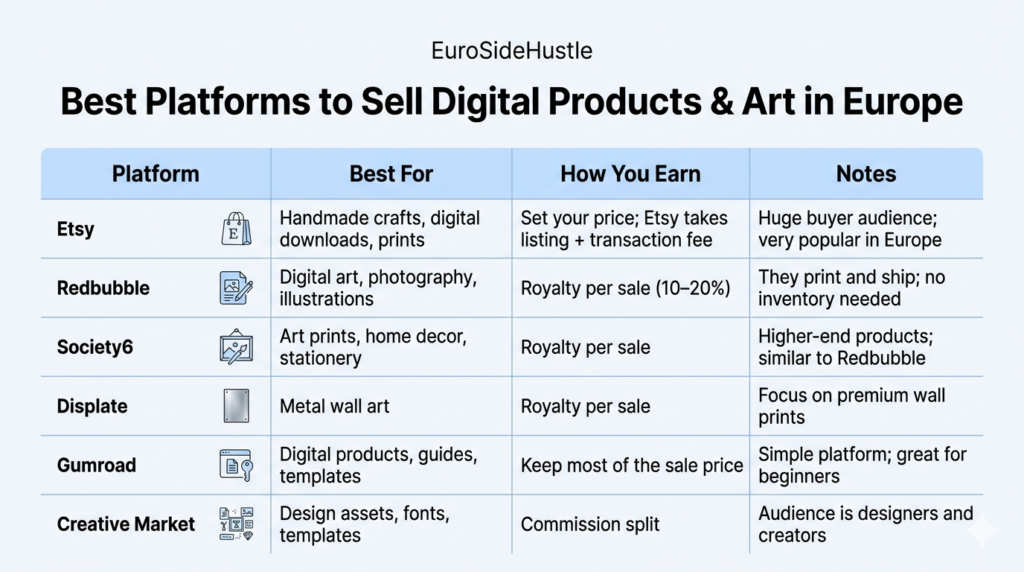
Infographic showing best platforms to sell digital products and art in Europe including Etsy, Redbubble, Gumroad and Creative Market with earnings and features comparison.
For complete beginners: Start with Redbubble or Society6 if you make digital art or take photos. You upload your work, they handle everything else, and there is no cost to join. Start with Etsy if you make physical items or digital downloads — it has the largest buyer audience of any creative marketplace in Europe.
Step-by-Step: How to Start Selling Your Creative Work
Step 1 — Identify What You Make and Who Would Buy It
Be specific about both parts of this question.
Not just “I take photos” but “I take photos of Irish coastal towns that people might want as wall art.” Not just “I make jewellery” but “I make minimalist silver rings that would appeal to people who like simple, modern designs.”
This specificity helps you choose the right platform, write better listings, and reach the right buyers.
If you are unsure whether there is demand for what you make, spend 20 minutes searching on Etsy or Redbubble. Type in what you make and see what comes up. If similar items exist and have reviews, people are buying them. That is your proof of market.
Step 2 — Pick One Platform and Create Your Account
Do not try to be on five platforms at once from the start. Pick one, learn it properly, and get your first sales before expanding.
The right choice for most beginners:
- Making digital art or taking photos? Start with Redbubble. Free to join, no inventory, global reach, and the upload process is simple.
- Making handmade physical items or digital downloads? Start with Etsy. The largest active buyer base for independent creative work in Europe.
- Making templates, planners, or guides? Start with Etsy or Gumroad. Both work well for digital downloads.
Create your account, fill in your shop name, add a short bio, and upload a simple profile photo. A complete profile looks more trustworthy than a blank one, even at the beginning.
Step 3 — Prepare Your Work for Listing
This step makes the difference between items that sell and items that sit unnoticed.
For digital art and photography:
- Export at high resolution — buyers who want to print your work need large files (minimum 300 DPI for print)
- Edit cleanly — light, natural editing looks better than heavy filters
- Create mockups showing your work in context — your photo on a living room wall, your design on a mug or phone case. Redbubble and Society6 generate these automatically. For Etsy, use free mockup tools like Canva or Smartmockups.
For handmade physical items:
- Photograph in natural light near a window — no flash, no dark corners
- Use a plain, clean background — white wall, light fabric, or a wooden surface
- Take multiple angles: overall view, close-up of detail, scale reference showing size
- Show the item being used or worn if possible — a ring on a hand, a mug being held
For digital downloads (planners, templates):
- Show a screenshot or preview of every page included
- Create a lifestyle mockup — your planner open on a desk, your template on a laptop screen
- Make the value clear at a glance — buyers should understand what they are getting without reading the description
Step 4 — Write Listings That Help People Find You and Want to Buy
A listing has two jobs: getting found in search, and convincing the person who finds it to buy.
Getting found in search:
Etsy and Redbubble both work like small search engines. When someone types “Dublin sunset print” or “minimalist silver ring,” the platform shows them listings that match those words. Your title, description, and tags must include the exact words your ideal buyer would type.
Think like the buyer. What would you type into Etsy if you wanted to find your item? Use those words — in the title, in the first lines of the description, and in your tags.
Convincing people to buy:
Your description should answer these questions in simple language:
- What exactly is this? (a digital download, a physical item, a print-on-demand product)
- What size, format, or materials?
- What will the buyer receive and how?
- What makes it special or personal?
Here is an example of a listing description that works:
“Sunset at Howth, Ireland — Digital Download Print. High-resolution photo taken on the north Dublin coast during a summer evening. Perfect for printing at home or at a local print shop. You will receive a JPG file ready to print in sizes up to A1. For personal use. Instant download after purchase.”
That is 55 words. It tells the buyer everything they need to know. Nothing wasted.
Step 5 — Price Your Work Fairly
Pricing too low signals low quality and devalues your work. Pricing too high without enough reviews to justify it leads to no sales. Find the market rate and start there.
How to find the right price:
- Search for similar items on your chosen platform
- Look at listings that have actual reviews — these are items that are actively selling
- Note the price range of the most popular listings
- Price your work within that range, adjusted for your specific quality and effort
General starting guides:
- Digital photo downloads: €5–€15
- Art prints (digital download): €5–€20
- Physical prints (framed, made by you): €25–€60
- Handmade jewellery: €15–€50 depending on materials
- Planners and templates (digital): €5–€25
- Template bundles (3–5 items): €15–€35
- Print-on-demand items (T-shirts, mugs): your royalty is typically €2–€8 per sale
For print-on-demand specifically, the platform sets the base price and you add your margin on top. Start with a modest margin to remain competitive, especially when you have few reviews.
Step 6 — Help People Find Your Shop
Uploading and waiting is not enough, especially in the first weeks when you have no reviews. You need to actively help buyers discover your work.
The most effective free methods:
Pinterest is one of the best platforms for creative sellers. Create a Pinterest account, create a board for your work, and pin your product images with clear descriptions. Pinterest pins appear in Google image searches and stay active for months — unlike social media posts that disappear within hours.
Instagram works well for visual creative work. Post your items, your process, and behind-the-scenes moments. Use relevant hashtags (for example, #etsyseller, #irishphotography, #handmadejewellery, or whatever fits your work). The goal is not massive follower counts — it is reaching a small number of people who are genuinely interested in what you make.
Facebook groups — search for groups related to your creative niche and your location. Many groups welcome creators sharing their work, especially when you contribute to discussions rather than just promoting yourself.
Word of mouth still works. Tell people what you are doing. Share your shop link. The first buyers are often people who already know you, and their reviews help you reach strangers.
The important principle: share your process and your story, not just your products. People buy from people they feel a connection with. A behind-the-scenes photo of you making your jewellery builds more trust than a product photo alone.
Step 7 — Review Your Results and Adjust
After your first month, look at the data your platform provides.
- Which items got views but no sales? This usually means the photos or description are not working, or the price is off.
- Which items got no views at all? This usually means the title and tags are not matching what people search for.
- Which items actually sold? Understand why, and make more like them.
This review process — adjust, try again, learn — is what separates people who give up after two months from people who build a steady income over a year.
Print-on-Demand: The Easiest Way to Start With Zero Risk
If you make digital art or take photos and do not want to deal with any physical products at all, print-on-demand is the cleanest entry point.
Here is the complete process:
- You upload a design or photo to Redbubble, Society6, or Displate
- A buyer finds your work and orders a T-shirt, a mug, a phone case, a framed print, or a canvas
- The platform manufactures the item, packs it, and ships it directly to the buyer
- You receive a royalty — typically 10–25% of the sale price — automatically
You never see, touch, or handle any physical product. There is no upfront cost. No storage. No trips to the post office.
The main trade-off is lower profit per sale compared to selling physical items yourself. A T-shirt that sells for €30 on Redbubble might earn you €3–€6. A handmade item sold directly on Etsy keeps a much higher percentage per sale.
The print-on-demand advantage is scale. Upload 100 designs. Each one earns occasionally. Combined, they generate consistent passive income without any ongoing effort.
A practical strategy: aim to upload a new design every week for three months. After 12 weeks, you have around 50 designs on the platform. Some will sell regularly. Some will never sell. The ones that do will continue selling for years.
What Sells Well in Europe Right Now
Based on patterns across creative marketplaces, these categories consistently perform well for independent sellers in Europe:
Photography:
- Local landmarks and cityscapes — people love art that connects to places they live in or have visited
- Nature and coastal scenes — consistently popular for home decor
- Abstract and colourful images — strong demand for bold wall art
Digital art:
- Inspirational and funny quotes — especially when niche-specific (coffee lovers, dog owners, specific cities)
- Animal illustrations — cats, dogs, and wildlife sell reliably
- Repeating patterns — used on phone cases, fabric, wrapping paper, and stationery
Handmade crafts:
- Minimalist jewellery — simple, modern designs sell across Europe
- Natural candles with interesting scents — strong market in Germany, France, and Scandinavia
- Pottery and ceramics — handmade mugs and plant pots have a consistent buyer base
Printable digital products:
- Daily and weekly planners — strong year-round demand
- Budget and finance trackers — particularly popular with 20–35 year olds
- Colouring pages for adults — steadily growing market
- Children’s activity sheets — parents buy these constantly
Seasonal opportunities:
- Christmas cards and gift tags in October and November
- Valentine’s Day designs in January
- Summer and holiday themes from April onwards
Seasonal content matters because buyers plan ahead, and platforms reward listings with early traffic. A Christmas design uploaded in September will accumulate more views and sales than one uploaded in December.
Tips to Earn More and Avoid Common Mistakes
Mistakes That Hold Beginners Back
Waiting until your work is “good enough. The only way to find out whether your work sells is to list it. Work that feels ordinary to you often looks original and charming to someone who does not make it themselves. Upload earlier than feels comfortable.
Ignoring search terms. On Etsy and Redbubble, buyers find your work by typing words into a search bar. If your title is “Sunset Photo” and buyers are searching “Dublin coastal wall art print,” they will not find you. Research the actual words buyers use and put those words in your titles, descriptions, and tags.
Taking poor photos of physical items. For handmade crafts especially, the photo is everything. A beautiful ring photographed on a messy table with bad lighting will not sell. The same ring photographed on a clean surface in natural light can sell consistently. Spend time on this.
Copying what is popular without adding your own angle. Trends are useful signals of demand, but buyers are looking for something that feels individual and authentic. Your specific location, your personal style, your particular way of seeing things — these are your actual competitive advantage. Do not erase them to look like everyone else.
Expecting sales in the first two weeks. Most shops earn nothing in the first month. Listings need time to be indexed by the platform’s search system. Reviews take time to accumulate. Momentum builds slowly and then accelerates. The sellers who succeed are overwhelmingly the ones who kept going through the quiet early months.
Tips That Make a Real Difference
Create in series, not singles. A set of five coastal sunset photos is more compelling than five unrelated photos. A matching collection of planner pages sells better than individual pages. Series give buyers a reason to come back to your shop and buy more.
Think ahead with seasonal content. Upload your Christmas-themed work in October. Your summer content in April. Your back-to-school content in August. Platforms reward listings that get early traction, and buyers who plan ahead are some of the most reliable buyers you will find.
Use the mockup tools available to you. Free tools like Canva, Smartmockups, and the built-in mockup generators on Redbubble and Society6 let you show your work in realistic contexts — on walls, on phones, on coffee mugs. Listings with strong contextual mockups consistently convert better than bare product images.
Reinvest early earnings into your next batch of materials or tools. If your handmade jewellery starts selling, use some of that income to buy better materials or equipment. Quality improves, prices can increase, and the shop grows naturally.
Engage with your buyers. When someone buys from you, send a short, friendly follow-up message thanking them and letting them know you are happy to help if they have any questions. Buyers who feel well-treated often leave reviews and sometimes return to buy again. A small shop with good reviews will consistently outsell a larger shop with none.
A Note on Legal Basics
The rules vary between European countries, but a few principles apply broadly.
Income declaration: In most European countries, hobby income above a certain threshold needs to be declared for tax purposes. What counts as a “hobby” versus a “business” varies, but if you start earning consistently, it is worth checking the rules in your country. Many countries have favourable thresholds for small creative income, but ignorance of the rules is not protection from them.
Copyright: Do not sell art featuring well-known characters, logos, brand names, or famous people without permission. This applies to fan art of films and TV shows, sports team logos, celebrity portraits, and parody items that still clearly use protected imagery. The platforms enforce these rules, and violating them can get your account banned.
Platform rules: Read the terms of service for any platform you join. Some platforms, for example, have specific rules about what can and cannot be sold as a digital download. Understanding these from the start saves problems later.
When in doubt, search in expat or creator communities specific to your country. Other sellers navigating the same rules are usually very willing to share what they have learned.
And Now, What To Do Next?
The creative things you do for enjoyment — the photos you take, the things you make with your hands, the designs you put together for fun — already have value to other people. They just do not know those things exist yet.
Every creative hobby described in this article is earning money for someone in Europe right now. Not fortunes. Not salaries. But real, steady, growing income from work they would have done anyway.
The starting point is simpler than it seems. Pick one platform. Prepare a handful of your best work. Write honest, specific listings. Then share them with the world and see what happens.
Here is what to do this week:
- Identify one creative hobby you already have — photography, drawing, crafts, writing, design
- Choose the platform that best matches it — Redbubble for digital art and photos, Etsy for handmade items and digital downloads
- Prepare three to five pieces of your best work with good photos or mockups
- Write listings with clear descriptions and specific, searchable titles
- Share your shop link in one relevant community or on one social media platform
Then wait, adjust, and learn. The first sale is the hardest. Everything after that gets easier.
Your creativity is already there. The infrastructure to sell it is already built. The only thing left is to connect the two.
What creative hobby are you thinking of monetizing? Drop a comment — sharing what you make helps other readers discover what is possible, and you might find buyers right here in the community.
EuroSideHustle helps people in Europe — including immigrants and beginners — build real income online. Explore more guides at EuroSideHustle.com.