
How to Make Money Selling Second-Hand in Europe
Complete Beginner’s Guide
This post may contain affiliate links. We may earn a commission at no extra cost to you.
The Saturday I Found Money in My Wardrobe
Cleaning the room — the kind of cleaning you only do when you cannot avoid it anymore.
And then a realisation: clothes unworn for two years. A phone replaced months ago, kept “just in case.” A lamp from the first apartment that never fit the new one. A pile of books already read and forgotten.
The room looked like a storage unit. The bank account was empty until next payday.
A Brazilian friend cut through it simply: “You’re sitting on money. You just haven’t sold it yet.”
That afternoon, Vinted was downloaded. Five shirts photographed, described, priced cheap — just wanted them gone. Within a week, all five sold. €60. For things that had been taking space and doing nothing.
That was the lesson: one person’s clutter is another person’s find. And in Europe, there are millions of people searching every day for exactly what you no longer want.
This guide explains how the whole thing works — which platforms to use, how to price, how to take photos that actually sell, what moves fast and what does not, and how to keep going after the first clear-out is done.
What Is Second-Hand Selling?
Nothing is created. Nothing is purchased upfront. There is no stock to manage, no products to source, no business to register. You simply take things you have stopped using, photograph them, describe them honestly, and make them available to buyers who want them.
Second-hand selling means listing items you already own on an online marketplace, and earning money when another person buys them.
This is different from dropshipping, reselling as a business, or any of the more complex online income models. Those require investment, planning, and ongoing management. Second-hand selling requires only what is already in your home — and a few hours to list it properly.
The appeal in Europe is particularly strong. Second-hand culture here is mainstream, not niche. Sustainability matters to buyers. The cost of living is high enough that people actively seek value. And the platforms — Vinted, Wallapop, eBay, Facebook Marketplace — are widely trusted and have enormous active user bases.
How Does It Work?
The process has four simple stages.
You identify what you have. Clothes unworn for a year. Electronics replaced but not discarded. Books already read. Items received as gifts that never suited you. Furniture that does not fit your current home. These are your starting inventory.
You list them online. Take photos, write a short description, set a price, and publish the listing on whichever platform suits the item. This takes 10 to 15 minutes per item once you have done it a few times.
A buyer finds your listing and purchases. They pay through the platform. You receive a notification.
You ship or meet. Package the item and send it with a tracked service, or arrange a local pickup in a public place. The platform releases your payment.
That is the complete cycle. The main variables — which platform to use, how to photograph, how to price — are what the rest of this guide covers.
Why It Is Worth Doing
The practical case for second-hand selling is strong, and it does not require any of the usual side hustle infrastructure.
You already have the inventory. Every other way to earn money online requires you to build or buy something first. Second-hand selling starts with what already exists in your home. The only investment is time.
The demand is real and active. Vinted alone has tens of millions of active users across Europe. Wallapop dominates in Spain and Italy. Facebook Marketplace is used in every country. These are not niche communities — they are mainstream platforms with daily active buyers looking for what you are selling.
The income is immediate. Unlike content creation, investing, or digital products — all of which take months to build momentum — selling second-hand can generate income this week. List today, sell this weekend, money in your account next week.
It clears your space as a bonus. The financial benefit comes with a physical benefit. A home with less clutter feels different. That is worth something beyond the euros.
It can become a consistent income stream. Once your own items are sold, the same skills and platforms work for buying cheap and selling at a profit — a simple model that some people in Europe use to earn €300 to €500 per month consistently.
The risk is zero. You are not spending money. You are not borrowing money. If nothing sells, you have lost nothing except some time. The downside is extremely limited.
Which Platforms to Use and When
Different platforms attract different buyers and suit different types of items. Using the right platform for each item means faster sales at better prices.
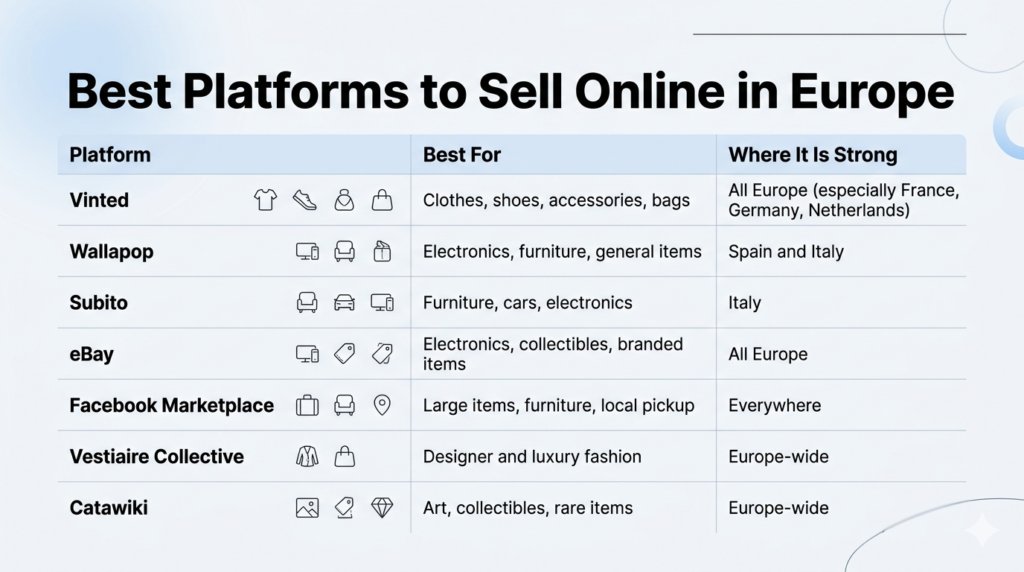
Clean infographic banner showing the best platforms to sell online in Europe, including Vinted, eBay, Facebook Marketplace, and others, with categories and regional strengths displayed in a modern table layout.
A practical approach: Do not restrict yourself to one platform. Clothes on Vinted, electronics on eBay, furniture on Facebook Marketplace. Each platform attracts different buyers for different things — using all three captures more of the available market.
Step-by-Step: How to Start Selling This Weekend
Step 1 — Do a Proper Declutter
This is not about being tidy. It is about looking at your belongings honestly and identifying what you have stopped using.
Go through each of these areas methodically:
Wardrobe and clothes storage: Anything unworn for a year. Anything that no longer fits. Anything bought on impulse and never used. Clothes that felt right in the shop but never felt right at home.
Electronics and cables: Old phones. Tablets replaced by newer ones. Headphones gathering dust. Chargers for devices you no longer own. Gaming equipment.
Books and media: Books already read and not likely to be reread. DVDs. Anything sitting on a shelf purely for decoration.
Kitchen and home items: Gadgets used twice and forgotten. Decorations from a previous home. Lamps, frames, small furniture that does not quite fit.
Everything else: Sports equipment from a hobby tried and abandoned. Gifts that were kind but not useful. Anything kept “just in case” that has been in a drawer for over a year.
The honest test: if you moved to a new home tomorrow, would you bother taking this item? If the answer is no, it is a candidate for selling.
Step 2 — Research the Price Before Listing
Pricing without research leads to one of two outcomes: you price too high and nothing sells, or you price too low and leave money behind.
Before listing any item, spend five minutes searching for it on the platform you plan to use. Search for the brand, model, or description. Look at what other sellers are asking — and, more importantly, look at what has actually sold recently.
On eBay, you can filter by “sold listings” to see real transaction prices. On Vinted, you can see active listings for similar items. This gives you a realistic price range to work within.
Note the condition of comparable items. If your item is in better condition than most listings at a given price, you can price slightly above the average. If yours has minor wear, price slightly below.
Step 3 — Take Photos That Do the Selling For You
Photos are the most important factor in whether an item sells. A great item with bad photos will not sell. A decent item with clear, bright photos will sell — sometimes at a higher price than expected.
You do not need a camera. A modern smartphone in good light is enough.
The method that works:
- Find a window with natural light — this is the single biggest improvement you can make
- Choose a clean, plain background — a white wall, a light wooden floor, or a plain-coloured surface
- Clean the item before photographing — wash clothes, wipe down electronics, dust furniture
- Take multiple shots: the full item, close-ups of brand labels or model numbers, any existing wear or marks
- For clothes, either hang them or lay them flat — never photograph them crumpled
One important principle: show any flaws. A small mark photographed honestly prevents disputes later. Buyers who know exactly what they are getting leave good reviews. Buyers who feel surprised by something they were not told about ask for refunds.
Step 4 — Write a Description That Answers Every Question
Your description needs to give buyers everything they need to decide — without requiring them to message you first.
A good description answers:
- What is it? (brand, model, size, colour)
- What condition is it in? (new with tags, like new, good, fair — be specific)
- What is included? (all original accessories, box, case, cables)
- What are the measurements? (essential for clothes — waist, length, chest)
- Why are you selling? (optional, but a brief honest reason builds trust)
Here is a description that works:
“Adidas running shoes, EU size 42. Worn around 10 times — still in great condition, no marks or damage. Selling because I switched to a different brand. Insoles included. Happy to answer any questions before you buy.”
Short, honest, specific. That is all it needs to be.
Step 5 — Price With Negotiation In Mind
Most buyers on second-hand platforms will send an offer lower than your listed price. This is normal and expected. The way to handle it is to price your items slightly above what you are genuinely willing to accept.
A simple rule that works: decide the minimum you want for an item, then list it at 20 to 25 percent above that. When someone offers your actual minimum, accept it. When someone offers below that, make a counteroffer. Almost everyone reaches a middle ground.
A general pricing guide for common items:
- Branded clothing (good condition): 30–50% of original retail price
- Electronics (working, in good condition): 40–60% of current market price for equivalent
- Furniture: 20–40% of new price, depending on age and condition
- Books: €1–€5 each, or bundle for €10–€20
- Sports equipment: 30–50% of retail depending on use
The goal at the start is getting sales and building a review history, not maximising every individual transaction. A seller with 20 positive reviews can charge more than a seller with none.
Step 6 — List at the Right Time and Respond Quickly
When you post a listing matters. The best times to list are Thursday and Friday evenings, and Saturday mornings — when people are browsing platforms during leisure time rather than at work.
When a buyer messages, reply the same day if at all possible. Buyers on second-hand platforms are often comparing multiple listings simultaneously. The seller who replies promptly gets the sale. The seller who replies the next day finds the buyer has moved on.
Most platforms show buyers when a seller was last active. A recent “last seen” timestamp increases buyer confidence. Check your listings regularly, especially in the first 48 hours after posting.
Step 7 — Ship Carefully or Meet Safely
For shipping:
- Use tracked delivery for every item — this protects you if a buyer claims non-delivery
- Pack more carefully than feels necessary — clothes go inside a sealed plastic bag inside the outer packaging; electronics and fragile items need bubble wrap; anything that could break gets treated like glass
- Take a photo of the packaged item before handing it to the courier — this proves condition at dispatch if there is a later dispute
- Ship the same day or the next day — buyers who wait more than 48 hours for tracking updates start to worry
For local pickup:
- Meet in a public place — a shopping centre, a café, a train station entrance
- Never give your home address to a stranger
- Bring exact change for cash transactions
- For high-value items (phones, laptops), trust your instincts about the buyer — if anything feels wrong, it is fine to cancel
The vast majority of transactions are completely straightforward. But building safe habits from the beginning means they stay safe even in the rare cases where something is off.
What Sells Best Across Europe
Understanding what moves fast — and what sits unsold — saves you time and sets realistic expectations.
Clothes that sell reliably:
- Branded items (Zara, H&M, Adidas, Nike, Levi’s, Mango) — brand recognition drives searches
- Winter coats and jackets — consistently high demand from autumn onward
- Vintage pieces — strong demand from younger buyers across all European cities
- Baby and children’s clothing — parents need it constantly, children outgrow it constantly
Electronics that sell quickly:
- Smartphones — especially iPhones; demand is always present
- Wireless headphones and earbuds
- Laptops in working order and reasonably priced
- Gaming consoles, controllers, and games
Home items that find buyers:
- Lamps and lighting
- Small, functional furniture — side tables, shelves, stools
- Quality kitchen items — stand mixers, good knives, espresso machines
- Decorative items in neutral styles
What tends not to sell, or sells very slowly:
- Very cheap fast fashion — items from stores like Primark often sell for so little it is barely worth listing
- Items with significant damage or staining — if it is in poor condition, donate it rather than listing it
- Highly personalised items — things that suited your taste specifically but would suit few others
- Broken items — these can sell if priced very low and the fault is clearly stated, but expect them to take time
Tips to Earn More and Avoid Common Mistakes
Mistakes That Cost Beginners Time and Money
Bad photos above everything else. The same jacket photographed badly might sell for €15. Photographed in natural light with a clean background, it might sell for €40. This is not hypothetical — it happens constantly. If your listing is not getting views or enquiries, fix the photos first.
Not responding to messages promptly. Second-hand selling is competitive. Buyers often message several sellers simultaneously. The first to respond with a helpful answer gets the sale. Waiting until the next day to reply is usually waiting until after the sale has gone elsewhere.
Pricing without checking the market. Listing based on what you paid or what you feel the item is worth — rather than what buyers are actually paying — leads to weeks without a sale. Search the platform first. Price based on reality, not sentiment.
Poor packaging. A sold item that arrives damaged is a refund request, a negative review, and a wasted sale. Pack everything as if it has to survive rough handling — because occasionally it does.
Not measuring clothes. Listed size and actual measurements are not always the same, especially across different brands and countries. Include the actual measurements in your description. This prevents the most common complaint in clothing sales.
Tips That Make a Real Difference
Bundle related items. Three similar shirts sold individually at €8 each become one bundle at €22. Buyers feel they are getting value. You sell three items with one listing, one shipping transaction, and one conversation. Bundling works especially well for books, clothes, and accessories.
Time your listings seasonally. Winter coats listed in August sit unsold. The same coat listed in September or October sells in days. Summer clothes listed in May sell quickly. Sports equipment listed at the start of a relevant season moves faster than at any other time. Think one month ahead of when the item will be needed.
Use every free platform feature. Many platforms let you “bump” or refresh listings so they appear near the top of search results again. These free bumps are often available once per day or week. Use them consistently — a listing that reappears at the top gets new eyes on it without any additional work.
Cross-post on multiple platforms simultaneously. The same item can be listed on Vinted, Wallapop, and Facebook Marketplace at the same time. When it sells on one, mark it as sold on the others. This multiplies your exposure without multiplying your effort.
Be honest about everything. Sellers with transparent, accurate listings build review histories faster. Buyers trust sellers with good reviews and pay slightly more without questioning it. Honesty about a small flaw in your description prevents a dispute that would cost time, stress, and possibly money.
What Comes After the First Clear-Out
Once everything you no longer need is sold, the natural question is: what next?
Some people stop there, with a clearer home and extra money. That is a perfectly valid outcome.
Others keep going — and this is where second-hand selling can become a consistent monthly income rather than a one-time event.
The options for continuing:
- Charity shop buying and reselling. Buy underpriced items from charity shops and list them online at market value. This takes practice to do well, but the model is simple and the margins can be good.
- Flipping free items. Many areas have “freecycle” groups — communities where people give away items they no longer want. Collect, clean, and list what others are giving away for nothing.
- Selling for friends and family. Offer to sell items for people who cannot be bothered to learn the platforms, in exchange for a percentage of the sale price. A 20% cut on items you did not own costs you only time.
- Seasonal clear-outs. Every three months, walk through your home again. Circumstances change. Things that seemed useful six months ago may no longer be. A quarterly routine keeps the habit active and the income flowing.
People who combine these approaches consistently earn €300 to €500 per month. Not from a business — from a habit and a set of platforms they already know.
And Now, What To Do Next?
Everything sitting unused in your home right now has a buyer somewhere in Europe. A buyer who would prefer to pay €15 for something you own rather than €60 for something new. A buyer who is searching on Vinted or eBay right now for exactly that item.
The only thing between your unused belongings and that money is the time to photograph, describe, and list them.
Here is what to do this weekend:
- Pick one drawer, one corner of a wardrobe, or one shelf
- Take everything out and sort it honestly: keep, donate, or sell
- For the sell pile: photograph in natural light, write simple honest descriptions, check what similar items are selling for
- List on one or two platforms — Vinted for clothes, eBay for electronics, Facebook Marketplace for large items
- Respond promptly when buyers contact you
Even if the first clear-out earns only €50, it proves the model works. And once you have sold a few things and felt how simple it is, you will look at everything in your home differently.
Your clutter is not a problem. It is inventory waiting to be listed.
What is the most unexpected thing you have sold? Drop a comment — the more unusual the better. Everything has value to someone.
EuroSideHustle helps people in Europe — including immigrants and beginners — build real income online. Explore more guides at EuroSideHustle.com.